
Protanopia – Red-Green Color Blindness
- Posted by Daniel Flück on November 16th, 2006 filed in Academic
- 51 Comments »
Red-green color blindness is split into two different types: Whereas people affected by protan color blindness are less sensitive to red light, deuteranopia or deuteranomly (the second type of red-green color blindness) is related to sensitiveness on green light.
| Gender | Protanopia | Protanomaly |
| Male | 1.01% | 1.08% |
| Female | 0.02% | 0.03% |
Protans have either defective long-wavelength cones (L-cones) or the L-cones are missing at all. If they are missing it is called protanopia or sometimes red-dichromacy. Affected persons are dichromats because they have only two working cone types, short- and medium-wavelength, compared to persons with normal vision with three different cone types.
If the L-cones are defective they appear in different intensities. This results in either a stronger or a weaker color blindness. If L-cones are not missing but defective it is called protanomaly. People suffering from this kind of color blindness are called anomalous trichromats.
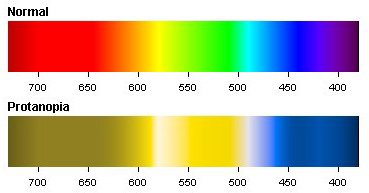
Protans have difficulties to distinguish between blue and green colors and also between red and green colors. When comparing the two spectrums you can see that there are different colors and shades of colors which are hard to distinguish for a protanopic person. So those persons are not only blind on red and green colors but a lot more. This means the well known term red-green color blindness is actually misleading and gives a wrong impression of protan color blindness (and also deutan color blindness).
Protanopia and protanomaly both are congenital color vision deficiencies. Their cause is an unequal recombination in the gene array which is passed on thereafter from parents to their children.
The genes encoding the L-cone photopigments are located on the X chromosome. This chromosome is also called the sex-chromosome, because women have two X’s compared to men with only one X combined with Y chromosome. If something is encoded on the X chromosome it is called sex linked. Sex linked traits are more often observed on men than women because a woman always has a second X chromosome which can compensate the deficiency. This unbalance between men and women can be seen in the table above showing the ratios of each kind of protan color blindness.
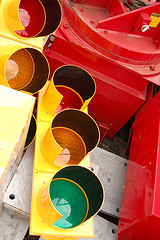
There are a number of studies which show that color vision deficiencies are a serious risk factor in driving. Particularly protan color blindness reduces substantially the ability to see red lights, regardless of the severity of the defect. Tests showed that protans were very much over-represented in an accident causing group of drivers mostly involving either signal lights or break lights. Some scientists estimate that being a protan has associated with it a level of risk of road accident that is equivalent to having a blood alcohol level of between 0.05 and 0.08 per cent. Because of that for example in Australia you can’t get hold of a commercial drivers licence since 1994 if you are suffering from protanopia or protanomaly.
Read more about Tritanopia and Deuteranopia—the other two types of color blindness.
Further reading:
Opsin Genes, Cone Photopigments, Color Vision, and Color Blindness
Protan Colour Vision Deficiency and Road Accidents
Wikipedia: Color Blindness
Related articles:
The Biology Behind Red-Green Color Blindness
Colorblind Population
At The Traffic Light
51 Responses to “Protanopia – Red-Green Color Blindness”
Please also consider to share your information or ask your question at the Color Blindness Forum, a place where people can find inputs, share stories, ask questions and more—all about color blindness. Join the colorblind community!

Some rights reserved.
June 26th, 2007 at 0:04
I am a protanopia, or Red and green color blind. This web site has helped me understand my impairment but i have a few questions.
Can Color Blindness Be cured?
Does Vision such as Near Sited and Far Sited effect my colorblindness?
(I am Near Sited by the way)
Are there contacts or glasses that fix my colorblindness like there are that fix vision?
Thanks
June 26th, 2007 at 12:04
I’m happy to hear, that through this article you learned more about your color blindness. Concerning your questions, I hope the following answers will help you to understand it even better.
Cure for color blindness: At the moment there is no cure for congenital color blindness. The Way to Cure Color Blindness? points you to a possible future.
Nearsightedness and color blindness: In over 99% this two effects don’t relate in anyway. There are a few cases found, where a strong myopia relates to some type of color blindness.
Contacts: There are some products available which claim to help improve color vision (ChromaGen). Be aware, that you can’t enhance the color spectrum you can perceive. So if can distinguish some more shades of certain colors, you’ll lose it somewhere else.
June 27th, 2007 at 20:58
thank you very much
October 10th, 2007 at 14:49
[...] at all, can find it hard to predict how their work will appear to someone with, say, protanopia, the most common form of red-green [...]
October 30th, 2007 at 10:07
[...] the male population of the world suffers from some form of color blindness. The most common being Protanopia, or Red-Green color blindness, the inability to distinguish between red and green hues. There is [...]
January 20th, 2008 at 14:27
Thanks a lot,your information is quite useful for my science study.
February 9th, 2008 at 18:54
can protanopia come to women too or is it only for men
February 9th, 2008 at 22:16
Merna: Yes, also women can be colorblind. But it is very uncommon, because women have to inherit the defective gene from their mother and father.
View some numbers at the article about Colorblind Population.
March 2nd, 2008 at 21:16
[...] su bandera. En realidad, todos los daltónicos, aunque no sean gays. Bueno, más exactamente un tipo de daltónicos, porque hay tantos tipos como personas aunque los agrupan en tres tipos, según con qué color [...]
July 8th, 2008 at 6:43
[...] me a protan, to be [...]
July 9th, 2008 at 6:20
Hi…
i just got my medical check up and it says that i’m a protanopia…
after reading this article, i got confused since i can see the difference between the red and green on the above picture (the normal color spectrum and traffic liight picture) but i do know that i’m a partial color blind
i got difficulties on differentiate composite colors
is there any explanation for that?
thanks…
July 9th, 2008 at 20:52
Prazz, I suppose you have only some mild form of red-weakness (protanomaly). Because of that you might have no problem to distinguish the shown pictures, but still have some problems with certain hues. The range of confusing hues would be just much smaller to you than to somebody with red-blindness (protanopia).
July 10th, 2008 at 3:12
Daniel, thanks for your detail explanation… guess you’re right about the problem with certain hues :D
i just hope there’s cure for this.. let say… umm… L-cones implant or something.. *lol*
August 28th, 2008 at 16:09
Hello
Can you confirm that if a woman has the sex linked color blind gene on both her chromosomes then she will be color blind??
August 28th, 2008 at 16:10
Sorry one other question and I know its unrelated but if haemophillia is also carried on one of the chromosomes why unlike color blindness can it not manifest its self in a woman, or am I incorrect in saying this??
Many thanks
August 28th, 2008 at 20:30
Avril, yes I can confirm, that if a woman has on both X chromosomes the defective gene, she is colorblind. Also for haemophillia it works exactly the same. Haemophillia is just so much more uncommon than color blindness, that almost no women are affected.
February 5th, 2009 at 0:38
Does protanopia or protanomaly affect the rod receptors in the eye? If so, how do they affect it and, in turn, how to the rods work differently? If that makes sense… I am an artist and not colour blind but I’m researching it for a very close friend of mine who has protanopia in hopes to eventually coming up with a valid cure. Thanks soooo much! =)
February 5th, 2009 at 9:59
Amelia, no rods are not affected by color blindness. Rods are used for night vision, they are very sensitive but can’t differentiate colors. – And unfortunately there is no cure for colorblind people.
April 12th, 2009 at 15:10
Hey, I’m Joseph, I too have Protanopia.
I can see all colors too, but I didn’t know this for sure until I was 15.
I think I have the same thing as prazz, and inherited this from my grandfather.
April 26th, 2009 at 19:11
Alot of this is false. I know for fact from books alot of this is wrong!
April 26th, 2009 at 19:14
Chuck, thanks for your hint. But please could you be more specific. Which information is wrong and what are your sources of information? I would be happy to learn more about it and of course adjust my writing, if anything is wrong. – Thank you very much.
May 19th, 2009 at 0:13
Although I thought I had partial red/green colour blindness – from an online check – I appear to have protanopia which explains why I also have problems with the blue green margins and colours like purple, mauve magenta etc and possibly why I only see 4 bands in any rainbow! I did buy a colour correcting contact lens about 8 years ago and wore it for a few months. What suprised me about the assessment process involved was the subjective choice of colour tint that I “felt” was better.
My initial reaction to using my chosen filter was how flourescent everything seemed and how much more visual “noise” there was in walking through any shop with fully stacked shelves containing products vying for attention through the use of bright colours!
The other strange experience I had was almost dyslexic in presentation. I found I was hitting computer keyboard keys a row above and to the right of where I intended (not being a touch typist I relied on visual feedback) Also when driving my peripheral vision gave the impression of road side kerbs floating about a foor higher than I expected. On one occassion I looked down at a welcome mat at a service station and the red writing on the green background was “floating” in the air. Very disconcerting! I stopped wearing the lens and it dried out through non-use.
I read somewhere that colour filters over the weaker eye have been used to help dyslexics avoid a similar feeling of letters floating about and understood the reason to be that the colour distortion confused the neurological mechanism at work in processing the light received on its journey to the parts of the brain used in processing the image and making sense of the real world.
As a result I thought this a more plausible explantion of my symptoms than the displacement of rods and cones which is how it was explained to me originally about 55 years ago.
I would be interested in your comments on my own experience.
May 24th, 2009 at 17:54
[...] Protanopia [...]
May 25th, 2009 at 8:47
I am colour blind and find that I can’t be a police officer, pilot in the army pretty much everything I want to be I can’t because I can’t see the number 56 in a bunch of colorful circles I find this highly unfair and discriminating!!! I can tell what colours are at a traffic light, see that if a person is wearing red or green, I’m not here to ask anything but mainly to see if anyone else out there is in the same boat as me, someone who wants to do something but can’t because of this rediculous disability to not see colours
July 27th, 2009 at 22:22
Very interesting reading, thanks for putting this all up.
I read your description of the Seekey, and wondered whether some red tinted sunglasses wouldn’t help me (protan color blind moderate according to your test) with driving?
I have never had an accident but I know that I am often late seeing a car’s brake lights or traffic lights at night.
July 28th, 2009 at 21:19
Guy, they might help, but you either need to take them on and off to get the contrast. Otherwise they just shift the colors you see and won’t really help.
Otherwise you would have to try to wear it only on one eye. In this case the brain gets some additional information which might help you in some specific cases.
August 8th, 2009 at 3:58
Just made it allot easier for my human biology assignment and to understand my dad’s condition
September 17th, 2009 at 9:15
[...] Red-green color blindness is a combination of red-blindness (protan defects) and green-blindness (deutan [...]
February 18th, 2010 at 10:16
My father has weak red green colour blindness. I am a girl, so does this mean I am a carrier? I have tested myself and know I am not colour blind. Does this mean if I have children, will they be colour blind?
February 19th, 2010 at 6:42
To Viennetta
Unfortunately you are a carrier
But your kids will only be colour blind if you partner with some who is colour blind, if so all your children with a partner(colourblind only) will be colour blind.
-I haven’t done this stuff in ages so Don’t take my word for it
Hope I could help
March 2nd, 2010 at 23:32
My son cannot distinguish between the red and yellow lights on the back of a school bus, nor the red and amber lights at a traffic light. As a new driver I have concerns about his ability to react when he is unable to distinguish between a blinking yellow light and a blinking red light. There is also the issue of right of way on the water at night with the red and green lights on the bow of a boat.
I see some discussions about tinted lenses and some rather significant side effects.
Looking for suggestions. Thanks.
March 3rd, 2010 at 5:19
To John, I too have heard tinted leanses might help the colour blind, But this may take years to Become a possiblity
Your son might Just have to become increasingly aware of his environmnt to Judge the situation and determine which colour is most likely
Good Luck
March 13th, 2010 at 16:49
Seth #1, Daniel #2:
As I noted over at the “deuteranopia” page, I’ve heard, long ago, of people putting a ruby (red) contact lens on one eye (apparently it takes a few months to adapt). I dunno if that would help much for dim lights, but it seems plausible in general. (Of course, it’s gonna look a bit odd to other people!)
Viennetta #29: Yes, you are a carrier, but Hudson is wrong: Your sons have a 50% percent chance of being color-blind. Assuming your husband is not color-blind, your daughters have the same 50% chance of being carriers(*). This applies to protan or deuteran types, tritan color-blindness is not sex-linked.
By way of illustration, my father was color blind; This implies that his mother was a carrier. I, being male, am unaffected (as my children would be, if I had some), but my sisters are carriers, and only one of my two nephews is color-blind.
(*) Actually, if he is color-blind, they still have a 50% chance of being carriers, but if they’re not carriers, they’ll be color-blind rather than normal.
March 15th, 2010 at 15:24
@ David Harmon
Thanks for the correction :D
April 8th, 2010 at 21:00
what is the chromosome number for color blindness??
What is the chromosome number for red-green blindness??
April 21st, 2010 at 5:45
@ Yajaira
Colour Blindndess is caused by chromosomal disorder of the ‘sex’chromosomes (The X Chromosome in this article)
It does not have a Number
Numbered chromosomes are called autosomes
Sex chromosomes Are X and Y
Hope I helped
June 20th, 2010 at 13:12
thanks Harmon and Hudson for the advice, I also found out my grandmother is colour blind as well. It’s really weak though and she can’t distinguish black and navy blue so it is defiently traceable through my family.
June 20th, 2010 at 13:17
Oh yeah I forgot to say this in the previous comments. My dad has Deuteranomaly. My grandmother has this too. Dad’s three brothers are also colour blind because my grandmother is. One of my uncles has very strong Deuteranopia and cannot distinguish the red, yellow and green of traffic lights.
July 2nd, 2010 at 12:44
[...] http://www.color-blindness.com/2006/11/16/protanopia-red-green-color-blindness/ [...]
August 2nd, 2010 at 14:24
hi
Why is the Color-Blindness gene more common then the Hemophilia A gene in females?
September 14th, 2010 at 13:33
in case of anyone interested my husband is colour blind, red, green thingy, our son is fine as I am not colour blind however all 3 of our girls have some form of dyslexia!!! x chromosome at fault perhaps
September 30th, 2010 at 9:17
My teen son can read some of the confetti charts, where the number or image in it is in primary colours but he can’t distinguish some shades of brown orange purple or green but will say they are one of the primary colours (whichever is dominant). He can name primary colours easily. If you put orange next to brown, he can’t differentiate or purple next to green he can’t tell which is which. He has been eye tested from a young age due to Iritis and the colour-blindness was never detected using the picture test, it was only as he aged that we thought he might be colour blind (three of my brothers are) that it was picked up and at the time, the opthamologist couldn’t really explain why he could determine primary colours but not composites. She theorised that perhaps he was able to detect subtle variances that helped him to learn to identify primary colours.
Do you know if there a name for it or have any explanation?
October 26th, 2010 at 22:32
Bron, it is very tricky to get to a conclusion about certain color vision anomalies. Unfortunately there is not just a simple answer for any of those color vision deficiency.
I suppose best is – if you really want to know – to check some more eye specialists and get a color blindness test battery which can help to get a better understanding.
- Daniel
December 17th, 2010 at 23:44
I took the test and (not surprisingly to me) got the “strong” protonopia result. What I find amazing is the fact that given the number of (mostly) males that are colorblind that this isn’t taken into account with traffic lights.
I have never been in a wreck (I am 51), but I have learned to compensate with the colors. The green light is on the bottom and looks white to me. The yellow is in the middle and looks orange. The red is on top and looks (sorta) red. However, if there is only one flashing light (red or yellow), I have a VERY hard time determining if it’s red or yellow especially if the sun is at a low angle and hitting the light. I slow to nearly a stop and see what the rest of the traffic is doing.
My point is why? Why? There are lots of other colors, or shapes, or numbers that could be used to eliminate this confusion. I won’t even talk about all the other “red/green” lights that I can’t tell the difference. It is very frustrating!
P.S. GREAT WEBSITE!
Ron
January 25th, 2011 at 6:53
I was told I have red-green colour problems as a child and I just went to the doctors and could barely read any of the cards. I think I have multiple types, is this possible?
February 1st, 2011 at 21:47
I am a female, and I am colour blind.
(I get to go on TV on Friday for it, so everything as it’s perks!)
February 9th, 2011 at 17:56
[...] -protan [...]
February 10th, 2011 at 5:02
“Cure for color blindness: At the moment there is no cure for congenital color blindness. The Way to Cure Color Blindness? points you to a possible future.”
Would evolution be the best cure? Our earliest primate anscestors were dichromats. I also read an evolutionary explanation of why red-green colorblindness, red weakness to be specific, is the most common, which had something to do with the detection of camoflage. These two thigns suggest that congential colour defficiency was more common only thousands of years ago, duing the stone age and earlier, than it is today.
“Because of that for example in Australia you can’t get hold of a commercial drivers licence since 1994 if you are suffering from protanopia or protanomaly.”
I hope you aren’t to weighed up about this. I hope such poeple don’t voulenteer to be designated drivers either.
February 12th, 2011 at 1:42
Thanks for your response Daniel. Still don’t have an answer but i’ll report back if we ever do.
April 18th, 2011 at 9:45
There are wonderful things about colorblindness, believe it or not, more people who are not color blind, are obliviously blind in other ways, that relate to color. Your not missing anything spectacular, and no cure is needed, people just need to understand that those who do not see full color spectrum, might actually be seeing a much better view.
May 9th, 2011 at 18:52
Red filters lighten reds and darken greens. A red contact would do the same, and winking the other eye will exagerate the difference. I speak as a photographic engineering technician and photographer, so there is hope for us. I do not have a red contact, but want one because I know they work.