
Deuteranopia – Red-Green Color Blindness
- Posted by Daniel Flück on April 17th, 2007 filed in Academic
- 83 Comments »
Deutan color vision deficiencies are by far the most common forms of color blindness. This subtype of red-green color blindness is found in about 6% of the male population, mostly in its mild form deuteranomaly.
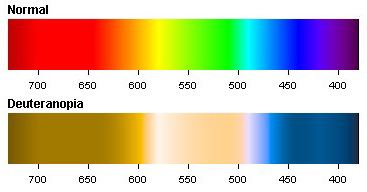
When you have a look at the color spectrum of a deuteranopic person you can see that a variety of colors look different than in a normal color spectrum. Whereas red and green are the main problem colors, there are also for example some gray, purple and a greenish blue-green which can’t be distinguished very well.
The well known term red-green color blindness is actually split into two different subtypes. On one side persons which either lack or have anomalous long wavelength sensitive cones (protan color vision deficiency), which are more responsible for the red part of vision. And on the other side deutan color vision deficiencies, which again are split into two different types:
- Dichromats: Deuteranopia (also called green-blind). In this case the medium wavelength sensitive cones (green) are missing at all. A deuteranope can only distinguish 2 to 3 different hues, whereas somebody with normal vision sees 7 different hues.
- Anomalous Trichromats: Deuteranomaly (green-weak). This can be everything between almost normal color vision and deuteranopia. The green sensitive cones are not missing in this case, but the peak of sensitivity is moved towards the red sensitive cones.
Below you can see a picture with normal colors on the left side and altered colors on the right side. The picture on the right side shows you how a person affected by deuteranopia would see the scenery (picture taken by Ottmar Liebert, some rights reserverd).

Normal Vision
|
Deuteranopic Vision
|
In the midst of the last century there were different researches published concerning unilateral deuteranopia. Some persons were found which had trichromatic vision in one eye and dichromatic vision in the other. The eye with dichromatic vision had a color specturm related to a deuteranopia color spectrum. One case of such a one-eyed colorblind is described in the article The Spectral Luminosity Curves for a Dichromatic Eye and a Normal Eye in the Same Person.
The one-eyed color blindness is definitely not the common case, whereas deuteranopia and especially deuteranomaly are the most observed cases of all color vision deficiencies. In 75% of all occurrences of color blindness it is a defect caused by the green sensitive cones. The following list shows the approximative rates of deutan defects in our population:
- Deuteranomaly, Male Population: 5%
- Deuteranopia, Male Population: 1%
- Deuteranomaly, Female Population: 0.35%
- Deuteranopia, Female Population: 0.1%
These numbers don’t change much, because deutan color blindness as one form of red-green color blindness is a congenital disease. Red-green color blindness is a sex-linked trait and therefore encoded on the X chromosome. Because women have two X and can overcome the handicap of one, men have only one and are therefore more often affected. This circumstance can also be read in the numbers of the table above. More details about the concrete inheritance pattern can be found at The Biology behind Red-Green Color Blindness.
If you are colorblind there is a big chance that you are red-green colorblind, usually green-weak and male. And if you are suffering from deuteranomaly I just want to let you know, that you are nothing special…
Read more about Tritanopia and Protanopia—the other two types of color blindness.
83 Responses to “Deuteranopia – Red-Green Color Blindness”
Please also consider to share your information or ask your question at the Color Blindness Forum, a place where people can find inputs, share stories, ask questions and more—all about color blindness. Join the colorblind community!

November 2nd, 2007 at 21:07
Im studying colour bilndness, Iv read several books including Diagnosis Of Defective Colour Vision by Jennifer Birch and Visual Perception a Clinical Orientation by Steven H. Schwartz, amongst others.
My question is why do dichromats and anomalous trichromats see what they see?. I understand that they either have a pigment missing or have a defective one but how does this influence the exacts colours they see?.
This what i think, a protanope should see blue and green as they are missing the red cone, i do not understand why they see blue and yellow and also why they dont see the green. Clearly my understanding is very limited and help would be much appreciated.
Thank you
November 6th, 2007 at 14:11
If you are protanopic or deuteranopic, colors along the line orange – red – green are hard to distinguish. It doesn’t mean you can’t see green. But you can’t distinguish it from orange or red.
The article about Confusion Lines of the CIE 1931 Color Space might give you a better understanding of the perception of a colorblind person.
November 25th, 2007 at 7:33
the theory is that it has to do with neurochannels that bring color information to the brain. the different wavelengths of light that are “seen” by the eyes are believed to travel to the brain through three neurochannels. One neurochannel handles red-green, one handles blue-yellow and one handles black-white. Combinations of these six colors make up all the different colors and shades that we see.
when someone is missing one or more of the cones in their eyes, it affects these channels. So missing low or mid range cones causes the red-green channel to fail. the result is that all colors that need red or green in it to form (including violet, orange, pink, etc) can not be seen. that leaves only the yellow-blue and black-white neurochannels able to do the job. thus the world is seen only in light and dark shades of blue and yellow.
same goes for blue-yellow colorblind people, who will see the world in various shades of green and red.
and people who are missing two cones, then both the yellow-blue and red-green channels fail, resulting in them seeing the world strictly in black and white.
i still don’t entirely understand the relationship between the missing cones, and the failure of the neurochannels. Logically, since there is considerable overlap of each cones scan of the visual spectrum, it seems to me that the remaining two cones should be able to process other colors. this may explain the varying degrees of colorblindness
one last thing. the names red/green/blue in reference to the cones is misleading. red cones actually peak at yellowish green, green cones peak at green and blue cones actually peak at violet. and each cone has a wide spectrum of what it ‘sees’. Red cones field of vision is almost identical to green ones, just angled slightly more towards longer wavelength light.
November 25th, 2007 at 17:05
heres a link that further goes into the relationship between r/g/b cones and the red/green, blue/yellow and black/white channels.
it also helps explain why people who are missing red cones can see such colors as yellow and white
http://webvision.med.utah.edu/KallColor.html
March 31st, 2008 at 6:53
Being a person with deuteranopia and looking at the comparison images is really kind of freaky. I see them both as the same–it’s quite sobering to see evidence that confirms my visual malady.
Thanks for detailed sites like this so I can just tell the people who out me as a colorblind person to go here instead of calling everyone over and giving me a “what color is this” test so everyone can laugh at the freak.
June 28th, 2008 at 23:20
What types of prefessions would this hinder? Such as a electrical tech or
computer tech?
July 1st, 2008 at 19:53
Chris, have a look into the professions category. I strongly depends on the severity of your color blindness and on your own judgment. Will you be able to do the job satisfactorily (for yourself and for your boss)?
August 2nd, 2008 at 8:21
The color spectrum looks like as blue hues are recognized, green hues are beige, red hues are brown, true cyan and yellow are bright; reds are percepted darker than greens.
So for normal sighted, looking through a blue filter is probably as close as they can get in hue to simulate the sight of a deuteranopic person. But for them the brightness its more like looking through a green filter.
August 27th, 2008 at 20:53
i have a Deuteranomaly, which means i have problems identifing red and greens right?
but on my case is differnet, i can see red and green individually different.
WHAT IS HAPPENING TO ME??!!!!
i recieve this result in a web test
and does this affect me from dirving in the furture?
and what are the careers that are affected by this??
-age 12 need help
August 28th, 2008 at 20:38
Killua, deuteranomaly doesn’t mean you can’t distinguish red and green. Just certain shades of those colors can cause problems. If you can get a drivers license depends on your local regulations.
Concerning careers I can tell you that in every job you can find a colorblind person. Unfortunately for certain jobs they make a lot of vision tests and want you to have normal color vision. It won’t always work to get police officer, firefighter or pilot.
August 28th, 2008 at 21:26
thank you for ur answer.
There’s another thing i wanta ask.
are there diffenet types of deuteranomaly, meaning how the amount of shades of a surtain red or green u can differentiate.
so can’t see much while others can identified the almost all kinds of shades from that particular hue.
Thnak you for ur help.
August 28th, 2008 at 21:40
Killua, protan deutan and tritan effects come in all kind of severity. They start at normal vision and go fluently to absolute forms. So some colorblind can only differentiate a handful of hues, compared to others who have almost the same color spectrum as people with normal vision.
August 29th, 2008 at 1:38
so as you added, the serverity may vary but once u aquired a type of colorblindness does the disorder worsen as ur age or by other factors or it stay as its?
And 1 more thing is there and nutritional foods that i could consume to improve/worsen my vision as a
deuteranomaly
-and your very nice =]
thank you very much for your answers, and they helped me greatly in understand more on color deficiency.(it was unbelievable at first, 2 days ago, when i was told i’m color blind. but now i feel better) Thanke Your one more time. =]
August 29th, 2008 at 2:07
I found my answer in the web below:
http://www.opticaldiagnostics.com/info/color_vision_defects.html
through my search for my unanswerd questions some are presented on the web above, hope it helps. for future refernence.
and thx to Daniel Flück who made me to believe that i’m not the only 1. 1/12 americans “males” according to studies.
September 1st, 2008 at 12:12
I sure can’t distinguish the two pictures above… I want to ask you how I can find out whether I have deuteranopia or deuteranomaly? All tests I can find are only color blind/not color blind tests.
Thank you for your help!
September 1st, 2008 at 14:57
Colorblind, I don’t know of any online tool which can tell you if you are missing the green cones or if you’re just suffering a deuteranomaly. I tried it with my RGB Anomaloscope, but it didn’t really work—yet.
If you go and see an eye specialist they can test your vision with a real anomaloscope. This is the most precise tool checking color blindness, and it can tell you this difference.
November 11th, 2008 at 18:21
I found this website so useful!It practically did myn homework for me and gave me triple the understanding. All the pictures made it very clear what colourblinded people can see. Now I feel as though I know everything about this particular subject etc
December 7th, 2008 at 23:19
I’ve waited years to graduate and join the Navy. I worked so hard to stay out of trouble. I’ve never been more excited then the day I went to MEPS, I planned on going into the nuclear program. Everything was perfect, my ASVAB was 92, and I automatically qualified for any job I wanted, but then they told me I was colorblind. It really hit me hard seeing the list of jobs I couldn’t do…
December 8th, 2008 at 16:59
Joshua, I just finished a 26 year career with the Navy as a Flight Engineer and I have a color vision problem in that I can’t pass the plate test. Did they offer you the Farnsworth Lantern (FALANT) test? In the Navy the FALAT is the law. They may screen you with the Ishihara test but if you can pass the FALANT which is just identifying small white, green and red dots of light from about 20 feet away you are good to go. It might be different for Nukes but I can’t imagine anything being more stringent than Navy Pilot/Aircrew vision requirements.
December 9th, 2008 at 15:51
Where can a beginning flight student find a Farnsworth Lantern test?
December 11th, 2008 at 17:07
I am fortunate as almost every Naval Air Station has a Farnsworth test and I still have access to them being retired. I have the aviation med tech write me a letter to take to the doctor explaining I passed it. The best way for a civillian to find one is to contact a service like Pilot Medical Solutions or AOPA and ask for a list of Doc’s that may have one. There are a some medical examiners that are also opthamologists that may have one or will accept a letter from an eye doctor who has one. There are other acceptable tests as well.
See this link to the FAA requirements
http://www.faa.gov/about/office_org/headquarters_offices/avs/offices/aam/ame/guide/app_process/exam_tech/item52/et/
Only do an operational test as (tower light gun signals and a Medical Flight test as a last resort. If you fail you will never be given the opportunity to take an alternate test again and you will be restricted from night/instrument flying permanently.
January 2nd, 2009 at 14:49
Should it bother me that I can’t see any obvious difference between the two pictures of the lizard?
January 12th, 2009 at 6:54
Yes, after I failed the plate test they gave me another test with tiny lights on top of each other. Failed that too. But sine then, I’ve gotten used to the idea of being colorblind and I went back to MEPS and picked a new rate. Now the only thing that bothers me is my shipping date being so far away.
January 12th, 2009 at 9:23
Yes, I should be bothered? ;)
January 15th, 2009 at 18:03
I am unable to see the red dot when instructors use a red laser pointer on a projection screen. My Opthomologist diagnosed me as having Deutan’s Defect.
Is there a type of lens or filter that could be used in eyeglass frames which would enable me to see the dot?
Thank you.
January 17th, 2009 at 10:07
I would have thought you would be of Protan defect not Deutan as stated by the Opthomologist, maybe i’m wrong?
January 24th, 2009 at 5:05
I can easily distinguish the deutan spectrum from the normal one.
I see the reds as red and greens as green
But i still fail the plate test, and cant distinguish the two images other than the slight hue difference in the floor.
am i color blind ?
March 7th, 2009 at 4:54
I’m intrigued by your site here…my son is color-blind of the Duetan type, which I discovered when he was ten. Soon after, my uncle told me that my grandfather was, as well. So I can certainly trace it in my family.
I found a site online that allows me to upload a photo and have it translated into supposedly what my son sees. Because I’m in a design profession, at first I was really sad about that fact that my son was c.b. But when I really got to look at the beautiful drawings and colors that he used (and saw them through the changed digital photo), I understood that he got just as much pleasure out of his color spectrum as I do in mine.
I’ve noticed he will generally be able to pick out and identify correctly colors as non-c.b. would, but the area of difficulty is in the darker end of the color ranges…dark green/black, etc.
In addition, I’ve heard him comment several times when there is a color I’d describe as a muddy brown — that this is a difficult color for him to look at — that it keep ‘switching’ to him between colors. I took a color theory class in college, and the professor said this ‘vibration’ commonly happens when two complementary colors of the same value are next to each other, and the eye keeps shifting back and forth.
But in my son’s case, it is just one color that vibrates. He says it makes him a little nauseated sometimes.
Have you ever noticed this?
March 11th, 2009 at 20:52
MiraMira, thanks for sharing your interesting story about your sons vision. – No, I’ve never heard of such a vibration. Maybe this has nothing to do with color blindness but some special memories (pictures, smells, …)? – Maybe some other readers now more about this.
May 9th, 2009 at 22:52
The lizard pictures look identical to me. I’ve never heard of the vibration, but I’ve had the experience of vascillating between what to call a color: “Is it brown? No, I think it’s green. Oh, maybe it is brown. Hmm, I can’t decide.” Years before I failed a color vision test for a naval scholarship, described in another post to this site, I had an argument with a friend over whether something was green or brown. I was probably about 9 years old at the time (64 now). My mother, 91 now, still talks about it, and it happened about 55 years ago! A couple of years after the green-brown dispute, someone showed me an Ishihara-type chart in a book, and everybody was stunned that I saw the “wrong” number or letter or whatever it was.
May 19th, 2009 at 11:44
Thank you for your article. I’m 26, I was always thought of by my parents as someone who couldn’t name some colors. I remember my mother insistingly telling me what’s green as if I just didn’t know how to associate the color with the name. I never thought much about it since I can certainly see color and I always thought that daltonism was just about seeing only in greys or something.
Recently I found a new traffic light near my work place and I was shocked that I saw the green as yellow even though I knew that had to be a green. I never had a problem with traffic lights but this one’s different from all the others with a different kind of light.
From that moment I realized that I actually had a problem so I’ve done some online tests that confirmed that. I can’t see any of the correct numbers on those dot circle images and I can’t see any difference in the lizard pictures.
I guess this is pretty late to find this out and I probably shouldn’t make any more websites on my own ;)
May 19th, 2009 at 11:50
MiraMira, I also don’t experience the vibration you’ve described. Maybe it’s unrelated?
Curtis, it’s funny that my mother’s insistence that I described before was also usually over green/brown shirts while shopping.
May 19th, 2009 at 15:09
Thank you for your comments, Sergio. I live in Calif. Standard green traffic lights look like a dirty white to me. As long as they’re always on the bottom of a stack of red-yellow-green, I’m fine. It’s isolated red and yellow lights that give problems. Is it red? Is it yellow?
May 24th, 2009 at 17:54
[...] Deuteranopia [...]
June 10th, 2009 at 2:18
Is there a way that someone with deuteranopia can prep to pass the Farnsworth D-15? For a job in law enforcement. Glasses or contacts which correct for this not allowed.
June 18th, 2009 at 18:55
We did a colorblind test and I saw a 2 instead of a 5. So I did a test on the internet, I sais that I’m 14%deuteranomaly. Should I be worried??
June 18th, 2009 at 19:36
“Worry” is pointless. If you’re colorblind, you’re stuck with it ’til your last breath! It’s akin to being “worried” about being short or a particular sex or a particular race. It’s you, and you’ll learn to manage your life, regardless.
June 23rd, 2009 at 6:07
I believe I have deuteranopia. Dark greens usually look brown to me. Blues sometimes look purple. When there are two thin lines next to each other, one green and one red, I can’t tell the difference between the two and they seem to be flickering and changing color between red and green (but more on he red side). My question is this. I can usually see red and green colors individually pretty good (unless dark greens which sometimes look brown to me). Does this mean that I can’t be a deuteranope since I can still see green?
June 23rd, 2009 at 6:22
I often see purple as blue. Seeing blue as purple (the reverse) is interesting and not what I experience. Purple is usually a difficult color for me to see, as is pink. I recently bought a Microsoft mouse that I thought was mostly silver for my computer, and my wife said, “Oh, you bought a pink mouse!” Like you, Maryan, I often confuse green and brown.
July 9th, 2009 at 6:01
I don’t know which type of color blindness I have, but I have difficulties with the following color schemes:
- Shades of green, I can see only some of them, like the green of grass.
- Mistakes with dark green and dark brown;
- Mistakes with dark blue and purple
- Light red and pink
- Shades that are between Light Green, Yellow and Orange.
What brings me difficulties is basically determining the name of colors. E.g. When somebody gives me a jacket that is brown, I don’t know that it is brown.
Or when I was a kid, I used to paint trees with mix green and brown in a wrong way.
So.. My problem is that I cannot see some shades of colors..
I guess that like others with the same problem, the best way to face this, is makin’ relations between the things (color versus objects).
’cause there are many things that always have the same color (especially products and logos) and even don’t knowing exact color we can guess which color they represents.
E.g.: Traffic signs are basically black, white, red and yellow.
Electronic products are black, whith, silver, gray.
P.S.: I’m from Brazil
Sorry for my english.. correct me, please
July 9th, 2009 at 6:40
Your English is good. No apology necessary.
August 2nd, 2009 at 19:56
[...] According to this color arrangement test, I have deuteranopia, the most common of all types of [...]
August 7th, 2009 at 8:06
I have deuteranopia. I just wanted to say that I found this site very useful overall, as were the pictures of the lizard.
September 17th, 2009 at 9:17
[...] #02 Red-green color blindness is a combination of red-blindness (protan defects) and green-blindness (deutan defects). [...]
September 18th, 2009 at 22:59
Maybe we aren’t doomed to our dying breath…google color blind squirrel monkeys. I still can’t tell if I am red or green deficient. I accidentally got into a field years ago that required normal color vision, but it wan not caught. i did fine, but they have added colors recently that would cause a problem if I were still in the field. I took the Farnswrth years ago and could not really distinguish between the three colors. I could see a difference, but I didn’t really know which was which. If at the beginning they would have said…this is red, this is green, and this is white…the results might have been different
September 22nd, 2009 at 20:31
[...] top has great bearing on possible underlying conditions that the user may have. In cases of Deuteranopia, the efficacy of both red and green top GH has not distinction. Persons with Tritanopia have a [...]
September 30th, 2009 at 14:08
Thanks for a very interesting website, Daniel.
I’m moderately badly colour blind, so for me red is a “not-there” colour, kind of like looking into empty space.
I was interested by the questions about careers. I have been a software developer and I am now a lecturer at a University in the UK.
Being colour blind has meant that I have a keen personal interest in user interface design, genetics and data representation. I think my “different perspective” is often a help.
Although I drive cars and ride a motorbike, stop lights and traffic lights are a problem. I am forced to use other cues to read the road, and I have to maintain a high level of vigilance. I never drive when tired.
I hope that’s of some use to other readers of this page.
October 18th, 2009 at 3:30
I apparently have pretty strong deuteranopia. When I was a kid I thought “green lights” must have been a reference to some time past when they were green, because they have always looked white to me. Some types of grasses look red. I can walk by a rose bush full of red roses and not even notice them because they blend in with the green. And the phrase “all the colors of the rainbow” confused me as a kid, “you mean both colors, right? There’s blue and there’s yellow.”
MiraMira’s son talked about a color vibrating back and forth. I too have this at times. I explain it like when you look at a wireframe drawing of a cube and if you focus on one square it appears to be in front, but then focus on the other square and it will all of a suddent shift the perspective of the cube and will now be in front. With colors that are difficult to distinguish between red and green, where they could be either, they will switch. What’s even more interesting is that I can think it’s red and it looks red, then I can think it’s green and it literally looks green! It’s pretty wild. It’s just an optical illusion that I believe some color blind people can do. I can do this quite consistently with stop signs when they are about a block away.
Question: Can someone have both Deuteranopia and Protanopia?
Thanks for this site! I’m anxious to show other people the lizard picture, cuz I’ve looked long and hard and see no difference whatsoever. It’s hard for me to imagine someone seeing a difference.
If you missed the story, there may be a cure for color blindness during our lifetime. Read how they cured color blindness in monkeys. I’d volunteer! I want to see what rainbows and fireworks really look like.
http://news.nationalgeographic.com/news/2009/09/090916-color-blind-gene-monkeys.html
Cheers!
October 23rd, 2009 at 3:41
I also have trouble seeing shades of color. I have taken many different test on the net but am not sure which kind of colorblind i really am.
November 10th, 2009 at 15:25
[...] fact, this image is an Ishihara plate that I’ve adjusted to mimic what someone with deuteranopia (a subtype of red-green color deficiency) would see. The original image looks like this:Most of you [...]
November 13th, 2009 at 16:54
Darryl, i dont know how to answer your question but i know what some of the situations you are going though are like. I too have a strong case of deuteranopia. i sure if you did enough research you could find the answer. And i can tremember the link but i found a power point about colorblindness on the web writen by a teacher in the airforce.
November 15th, 2009 at 15:40
Mr. Nic Shulver,
Are you a University profesor? I am also interested in applying for academic position in a universty. I was thinking if my color vision deficiency may hinder my job prospect in academic field.
Please send me reply at vishwanath_nagarajan@yahoo.com
December 14th, 2009 at 0:15
hi,
i done some colour-blind test.
-the result is i have deuteranopia and protanomaly most.
can this disturb my driving when i be an adult.
reply a.s.a.p please.
thank you.
December 14th, 2009 at 1:25
It seems that most signal lights take into consideration the color blind. Green lights look white to me, not green, so I never confuse them with red lights. The only two problems I have is that sometimes green lights (white) blend in with the street lights at night, so I can be surprised when it turns yellow. The second problem I have is when a stop sign is in front of bushes; depending on the color of the bushes, it can make it more difficult to notice.
Darryl
January 5th, 2010 at 23:52
From a test on this website, it has showed me that I slightly have deuteranopia, but very slightly, does anyone confidently know whether this will affect a career in the police? On websites i have looked at, it stated something about monochats (i think) will only be rejected from the police. Any help please?
January 28th, 2010 at 23:27
Thank you for the pastel shades test – it showed I am strongly Deutan.
Years ago at home we had a set of curtains that I saw as every different colour imaginable from yellows through to blues. And very pretty they were, too. But my family were amused to tell me it was all green – different versions but all green.
Life can be more fun for us Deutans!
:-)
January 29th, 2010 at 22:45
23 years old and just realized I’m deutan… :’(
February 1st, 2010 at 17:38
Which is the exact test for deutrenopia i think i have a bit of problem but not 100% sure.
February 13th, 2010 at 5:50
[...] Gamer’s comparison after running a screenshot through a color contrast analyzer. Players with deuteranopia (6 percent of men, 0.1 percent of women) or protanopia (1 percent of men, 0.01 percent of women) [...]
February 20th, 2010 at 13:31
I am 24 years old & a Telecom Engineer during my internship I came to know I am color blind as I cannot say which color the equipment is indicating red or green but I can differentiate between red & green when put together.
I don’t understand how could this happen to me!
February 23rd, 2010 at 16:09
@asad … its just normal dont worry too much ,if in normal life you can differentiate between red and green stuff then its ok, actually the colour tests can find even your minute disorders , as 1/10 mens are slight colour blind from birth..
so dont get worried too much its normal if you can spend life with it easily.
March 13th, 2010 at 16:24
Dennis #25: Is there a type of lens or filter that could be used in eyeglass frames which would enable me to see the dot?
I’ve heard of people putting a ruby (red) contact lens on one eye (apparently it takes a few months to adapt). I dunno if that would help much for dim lights, but it seems plausible in general. (Of course, it’s gonna look a bit odd to other people!)
April 22nd, 2010 at 3:44
Hi, I have read numerous articles about color vision deficiencies and it seems to me that they give off different info.
Would you kindly, in a nutshell, tell me just the basics of the types of color-blindness?
April 23rd, 2010 at 21:37
Curious, have a look at Color Blind Essentials, which is an overview with detailed information about all facets of color blindness.
May 11th, 2010 at 1:34
I’ve been colorblind for 26 years and was only recently tested for it. I have always found some aspects of colour hard to understand.
Wasn’t until I mentioned that I had Irlens Syndrome that I was tested for the colorblindness, and low and behold i have problems with the color red.
I’ve not let this issue stop me from doing what I want, and I got myself a university degree in IT and with other learning difficulties too such as dyslexia and being partially sighted this has been one hell of a task.
But colour blindness shouldn’t stop anyone doing what they want in life.
June 9th, 2010 at 22:14
I live in New Jersey and am color blind(red-green). Will I get a driver’s license?
July 2nd, 2010 at 12:44
[...] http://www.color-blindness.com/2007/04/17/deuteranopia-red-green-color-blindness/ [...]
August 1st, 2010 at 18:24
[...] personas aunque los agrupan en tres tipos, según con qué color tengan problemas: con el rojo y el verde o con el amarillo y el [...]
September 23rd, 2010 at 16:00
I would like to share some of my experiences of having colour blindness.
My grandfather was a paratrooper in ww2 and would spot the enemy in camouflage.
Once I tried competing at shot-put but couldn’t see the red spray paint markers on the grass and I didn’t know where to throw the shot-put from.
I am usually fine with traffic lights except when the black border is a dark shade of green.
I have always had trouble telling the difference between blue and purple.
Green and red together create an optical illusion where the colour flickers and has fuzzy textures.
October 3rd, 2010 at 10:56
“that you are nothing special…” OUCH
I’m actually Deuteranopiac – but way to sound devoid of empathy. I’m going to assume you don’t have Deuteranomaly; and that you’re probably “normal” visioned. But being 5% of a population makes that very significant, actually.
Statistics, bub.
October 7th, 2010 at 7:17
I’m have a colorblindness and I just found out a year ago in freshman year. I remember in kindergarten they told me to color the rainbow in the right order and I would always get it wrong.
I have a hard time depicting red from brown and blue to purple.
October 19th, 2010 at 0:13
I´m deuteranomalic but excluding that my vision is nearly flawless, including excellent depth perception. Or so I was told during my military service as forward observer (infantry).
During the service I also realized that I had far superior night vision compared to others in my unit.
I could easily recognize faces and operate equipment normally in lighting conditions that required others to use flashlights to be able to do anything.
It was also very fun to be able to navigate in the forest at night with ease and hear the officers stumble right behind me.
Spotting camoflauge was also something
I was very good at. The red targets in the firing range proved much more challenging, although after someone had pointed them out to me once I could find them again without help – and then they would appear red to me.
I´d be interested to hear if anyone has had any similar experiences or if anyone knows if there has been any reseach on the subject?
October 20th, 2010 at 21:40
I have a question. I can distinguish red and green, but when I see a bright neon red in the background and green lettering, the words seem to melt together. Like, last year during Christmas time I saw these bags, and they all had neon colors. Yellow, purple, blue, so on. I could read all the lettering of the bags except for red and green. And sometimes a case of black with bright red lettering.
Sometimes I’ll see colors differently. Like certain shades of silver look purple to me, or sometimes black looks brown or vice versa. I don’t understand it.
Is this the same as Deuteranopia?
October 20th, 2010 at 21:43
Eivana, please try some of my Color Blindness Tests as it is not easy to tell from some perception is someone is colorblind or not.
- Daniel
November 10th, 2010 at 17:14
Hm, not so good, is there any possibility to help the people? i hope so .. all the best!
Greetings from Hamburg
November 29th, 2010 at 17:36
Mr. Daniel Flück,i just want to ask…why did you say that people which suffering from deuteranomaly is nothing special?no offence..just asking
November 29th, 2010 at 21:57
Nu’man, compared to all the other types of color vision deficiency, deuteranomaly is by far the most common form. And looking at it this way, it’s nothing special.
December 1st, 2010 at 22:05
Thank you for this article, it’s great to see so many people who also see how I do… I thought I would share quick story about how it affected me growing up. I’ll start off by saying I had no idea I had issue until I was 8-10 years old. Well way back in kindergarten they where teaching us colors by making us use coloring books and coloring things like their real life equivalent. At that time I thought colors are like any other subject (getting better with practice) So I would ask my sister to confirm colors, find certain ones, etc. Well the teacher caught on and complained to my parents and the principle. She basically accused me of being a lazy cheater, and it resulted in my sister and I never being able to be in the same class for the rest of our time at that school.
I also thought I would confirm this “vibration” of colors mentioned in a previous comment, small things only for me though. For example take a red and green pen and put one dot of each next to each other, they constantly switch/flash on me.
December 8th, 2010 at 3:40
[...] Deutan colour vision deficiencies are by far the most common forms of colour blindness. This subtype of red-green colour blindness is found in about 6% of the male population, mostly in its mild form deuteranomaly [...]
December 24th, 2010 at 13:27
Just discovered your site. Wow! It’s amazing to read some of these comments and finally realize there are others out there who might see colors as I do. The “vibrations” / “color switch optical illusion” is something I’ve tried to explain to friends & family but they have never understood. When I took the Color Arrangement test on here, I had a hard time as the color blocks would shift their color and basically if I stared at it long enough it would appear to be just 2 colors.
Reading through the comments it would appear that there are a lot of young people who are afraid how this is going to affect their life. In a nutshell, it doesn’t for the most part. Yes there are certain jobs that require. I was in the Air Force for 10 years. I wasn’t supposed to be to get a job on the flightline, but I asked if I could take a real world test. I had them first show me each light and tell me the associated color. After that brief “training”, they show me the lights again and I had to name them as the light was flashed. I scored 20 out of 20. The flightline manager said that Non-colorblind don’t realize we colorblind still see color and can differentiate between colors if we are given a chance to “train” our eyes. The problem is when the color comes out of nowhere and we’re asked to determine the color name without any previous comparisons. As far as driving, I’ve been driving for over 25 years, and in that time I can probably count on one hand how many times I’ve actually seen a green light! Whenever it happens that a green light is actually green to me, I usually hoot-n-holler with joy! Most of the time the green light is white to me, which sometimes if I’m driving at night in a new city, does make it difficult to distinguish between traffic light and street lights. The other issue with driving are those intersections usually in rural areas that have a flashing light, sometimes red, sometimes yellow. If I can’t determine which color it is – I just come to a complete stop before proceeding or ask a passenger.
To the young guys who are worried about their newly discovered colorblindness – don’t worry & use it to your advantage! I’ve gotten more dates & telephone numbers, talking about my colorblindness. Usually it’s when I’m shopping for clothes – I’ll find a cute salesgirl to ask if she wouldn’t mind helping me pickup clothes since I’m colorblind! Works every time!
Anyway it’s nice to know there are others out there that are as severely colorblind as myself.
January 29th, 2011 at 18:42
I’m not sure if I’m protan or deutan, but those lizard images look exactly the same. But a couple of tests (online) have told me or shown that I’m protanopic. Except one test on here (the Farnsworth test) says I’m severe deutan. I wish I could find out exactly which one I am, as online tests aren’t entirely the most accurate. I usually have difficulty with greens, such as dark green and brown, green grass and orange, light green and yellow, sometraffic green lights look white and cyan/blue green looks grey. I also have difficulty with dark red and brown, and blue and purple. I have difficulty with other colors too, but those throw me off the most.
My mom thinks I could have both protan and deutan defects. But I don’t think that’s possible, is it?
May 1st, 2011 at 6:43
hello,i am come from hong kong,i think those informtion is useful that make me know more about color blind.
I know I am Deuteranomaly/Deuteranopia,I just ask is I see the world is same or not of other?(my English is not very good,Sorry for the inconvenience caused!)
May 6th, 2011 at 5:29
What is the difference between Deuteranopia and Deuteranomaly ?? Is people who suffers deuteranomaly cannot recognise green ,while Deuteranope can only see some hues of green ?? Is it like that?