Do Color Blind People Perceive a Colorful Life?

Sarah contacted me to learn more on how color-blind people perceive our colorful world. Everybody can generate images which simulate this visual handicap with my color blindness simulator Coblis. But this isn’t the whole story, as those pictures can’t tell you how colorblind people think about this colorful—or in this case colorless—world.

Sarah put together some really interesting questions concerning the perception of color and how I handle this as a quite strongly colorblind man. Here are my answers to her questionnaire:

Colorful Dancer
Colorful Dancer

Sarah: I’m interested in the perception of color to one’s self, mostly. How do you describe colors to yourself (when others are not around)? For instance, what does ‘colorful’ mean to you? Do you conjure up an image of rich blues, yellows, and whites, or do you include red and green (what you perceive to be red and green, anyway) in that definition?

Colblindor: I included this picture as an example for what colorful means to me. If it includes red or green, I can’t tell you. So I can not tell you which colors I explicitly include to name something colorful as I can’t name them. I would say a colorful thing needs at least three to four clearly distinguishable colors for me. This could also be a fire truck red and a grass green combined with some blue or yellow. On the other side I can tell you that there are certain pictures which are not colorful for my eyes but seem to be colorful if you are not colorblind yourself.

Sarah: In your own mind (just yourself, all alone), do you describe the world around you in shades of blue and yellow, or do you throw red and green into the mix? For example, if you saw a brightly lit Christmas tree, would you say to yourself that you see a lot of blue and yellow lights, or would you describe colors you think might be red, green, purple, etc.?

Colblindor: If you dig a little deeper into the topic of color blindness you can learn, that moderate to strong color-blind people have problems along the whole color spectrum (see Colorblind Colors of Confusion). I am strongly red-blind and therefore have also problems for example with blue/violet/purple or blue-green/gray/purple. — Personally I would say I don’t attach color names to my visual perception. I only name them when somebody else asks about it and this very often puts me into a position, where I just can’t name it or even describe it properly.

Sarah: Do you describe things to yourself as being red/green/etc. when the situation does not call for a need to tell the exact color? For example, grass is green and everyone is taught this at a young age, but when you’re just walking around by yourself, do you ever mistake grass for being yellow/another color (before remembering it’s green)?

Colblindor: As I described above I don’t really actively perceive colors attributing names to them, only if I learned the color of something (green grass). In this case I just know the color name but don’t clearly perceive it. Therefore I can’t really say that I sometimes mistake anything for having a wrong color. Sometimes I get confused if I know something always has a certain color (for example red) and I perceive it completely differently. In this case I ask myself if this is really the color it should be or if the source of the problem is somewhere else.

Colorful Rainbow
Colorful Rainbow

Sarah: I can use certain color filters that show me what some images might look like to someone with a color vision deficiency. To my color normal eyes, these filters for red-green deficiency make a rainbow look like a streak of yellow in the sky. Is that how you would describe it too? If not, how do you perceive it?

Colblindor: Rainbows look like rainbows. Rainbows are not to colorful for my eyes but anyway a beautiful phenomenon. In colors I would say blue-something-yellow-some other color streak. By the way, the picture wall on this image looks very colorful to me, even if I can’t tell you at all which colors I see.

Sarah wants to learn a lot more about color blindness. She says: “I’d love to talk to anyone with any form of color vision deficiency”. So if you feel like chatting just contact her directly at sarahvas84@gmail.com.

Rainbow photo by Cavin

The Color Blind who Feels Colors — Synaesthesia

I am colorblind and don’t have a very broad color spectrum. Because of that it is even harder for me to believe, that there are some people who not only can see colors with their eyes but in a way feel colors or see them with an extra inner eye. Every thing, even abstract terms, letters, numbers, just everything is associated to a color or several colors.

Colblindor Synaesthesia
As a word it would be a mixed pink-yellow-white color.

Ying, a women who is gifted with this very special ability, contacted me a few weeks ago and I could learn from here explanations a lot about grapheme (color synaesthesia): An individuals perception which is involuntary, consistent, and memorable associated with the experience of colors.

Basically I never really thought about this, but most things (real, abstract, imagined) has a color to me since I was a small child. The assignment of colors seems to have no reason or any rule at all, yet remain consistent. i.e. The days in a week: Monday is silver white, Tuesday is grayish blue, Wednesday is deep pink, Thursday is green, Friday is mustard yellow, Saturday is red, and Sunday is pale yellow. All the numbers have a color, too, as well as things like directions, months, abstract things like gravity (do you know gravity is steel gray to me?)…etc. I didn’t think it’s weird until my friends said it’s weird and they don’t think like that. I can speak three languages and the colors of things don’t always match in different languages. i.e. the word “wife” in English is a gray color, it’s equivalent word in Chinese is a dark red color. I can’t really explain them. Like I can’t explain why bananas are yellow, well because they are yellow as a fact.

I added a few more questions to this first introducing statement so I could learn more about synaesthesia. Here are a some more of those very interesting facts about it.

Colblindor: What about some specific words. Do they always have a specific color? Is angry really red, calm green and hot red, cold blue?
Ying: Ok about the colors of words: yes those words definitely have consistent colors to me. I have to mention that words have no colors until you understand them, and I didn’t start English until my late teens. My sense of colors might be off from authentic English speakers who learned them as little kids. :) Anyway, hot is orange to me, almost burnt (dark) orange, cold is steel gray, angry is a whitish blue, same color as “air”, calm is a watery dark blue. The thing is, many words don’t have a solid color, they frequently have 2 or 3 colors and have a swirly or mottled look. Only very simple things like simple digit numbers or the alphabet have a single color.

Colblindor: Do you in some way “see” this colors or more like “feel” them?
Ying: I’m a very visual person, so I would say I rather “see” them then “feel” them.

Coblindor: Do you think it is a gift, a handicap, or something you would prefer not to carry around with you?
Ying: It doesn’t affect my daily life much at all. I’ve only ever brought it up a few times with some very close friends and was surprised that they don’t have it. It might help me remember things and names better. I’m not sure if it has any other use.

Colblindor: Do you know other members in your family who are feeling the same?
Ying: I never talked to my parents or siblings about this so I don’t know if they have that or not.

Now there is no obvious relation between color vision deficiency and grapheme. What if you combine both of them? — You wouldn’t be really able to see all colors with your eyes but feel and automatically associate colors to everything. Could you “feel” more colors than you perceive?

Fact is that Yings both sons claim to have also an inner eye which relates colors to things; and one of her sons is colorblind.

If you want to learn more about synaesthesia read this excellent description from Cassidy Curtis at otherthings.com. There is also an interesting site from the University of Sussex about their ongoing synaesthesia research.

The Cure of Color-Blind Monkeys

If you believe it or not, but a team around Jay Neitz could cure monkeys suffering from red-green color blindness by injecting the missing red pigment genes into their eyes.—How does this work and could is also get true for you and me?

Cured Monkey Dalton completing his
Color Blindness Test

How can you cure color blindness?

First of all the team of researchers needed some test persons—in this case some adult male squirrel-monkeys which are colorblind from birth.

This monkeys are missing long wavelength cones and therefore their vision is comparable to protanopia, a specific form of red-green color blindness.

The chosen monkeys were trained on some form of color blindness test: Whenever they touch the screen where the colored area is shown, they get a drop of grape juice. Watch the video to see how the test works.

After some time two of the monkeys—Sam and Dalton—received an injection behind their eyes retinas. The injection inserted viruses carrying a gene that makes L-opsin, one of three proteins released when color-detecting cone cells are hit by different wavelengths of light.

And after the treatment nothing happened…

Only about five months later Sam and Dalton started to get better on their test. The video above shows Dalton on a perfect run, something he could never achieve before the treatment.

What has changed in the color perception of the monkeys?

Jay and Maureen Neitz explain it on their website as follows: Before the treatment the monkeys had only two perception patterns which could differentiate hues, S supported by M and M supported by S. The insertion of the third opsin gene gave rise to new color perception stimuli: M supported by L+S and L supported by M+S.

After a while the brain started to react on this new information. Gaining this new dimension of color vision becomes a simple matter of splitting the preexisting blue-yellow pathway into two systems, one for blue-yellow and a second for red-green color vision; which sounds almost to simple to be true.

When will we be able to cure color vision deficiency?

Nobody knows the answer on that question. But people like Jay Neitz think that this could get true in the near future. You shouldn’t be to optimistic yet as it still needs a lot of testing. First of all the proposed gene therapy also has to be save for humans, which will take quite a while to accomplish and to show to be true.

After that it is not sure what the internal perception of this new colors look like and if there are any psychological side effects—Sam and Dalton didn’t show any, but they can’t tell us what they feel like. The Neitz Lab team lists the following risks:

  • Gene therapy for red-green color blindness may not work in humans as well as it does in the monkeys.
  • Side effects of subretinal injections can include irritation or infection, in addition to the risks of permanent retinal detachment and blindness at the injection site.
  • There could be adverse psychological effects associated with suddenly being able to see new colors and learning how to categorize them.

And on the other side of course the benefit, that you my colorblind fellow could start to see the world much more colorful and experience a supposedly overwhelming colorized life.

Keep your eyes on the latest outcomes of this new gene therapy for color blindness. But please don’t be frustrated if this never comes true in the time you hope for it. If you master your colorblind life with ease you won’t get disappointed if it doesn’t get true but maybe positively surprised!

Thanks to Bob, Martin, and Mac for pointing me so quickly to this new exciting results!

We are colorblind.com

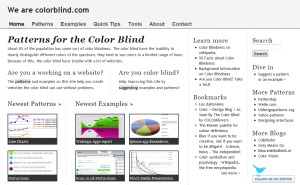
Tom van Beveren from the Netherlands put together a very comprehensive site on all sorts of stuff people should know, if they want to build/design a website which doesn’t exclude colorblind visitors. Because almost 5% of all people are suffering from some form of color vision deficiency, this is something every web publisher should care about.

we are colorblind
wearecolorblind.com

The site We are colorblind.com includes a lot of very interesting topics related to color blindness on the web. It is structured as follows:

Patterns for the Color Blind: A list of very useful patterns you can follow while you’re designing your web content. If you follow those patterns, colorblind people will definitely find their way around on your page.

Quick Tips: This section provides supportive information for all the patterns from the above mentioned list. If you dig into the quick tips you’ll learn more on how color blind people see the world and how you can use this information.

Color vision and web Tools: Hopefully this is an ever growing list of great tools to help you while you are building your web site or just on your way through the web.

Good and bad online Examples: The examples section gives a good overview of good solutions, which help people with color vision deficiency. The list also includes bad examples; web sites unusable by color blind visitors.

If you think about building a new web page, redesign your site or get your online content ready for colorblind visitors, make sure you visit wearecolorblind.com and follow the tips and patterns provided by Tom.

Tom: Really great work! Thanks.

Free Lecture: Colour Assessment & Diagnosis Test

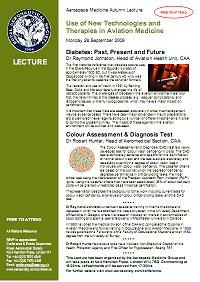
color-assessment-diagnosis-test-lectureThe Royal Aeronautical Society will be holding a Lecture in London on 28 September relating to Use of New Technologies and Therapies in Aviation Medicine.

One of the speakers is Dr Robert Hunter, Head of Aeromedical Section, CAA. He will be talking about the new Colour Assessment & Diagnosis Test.

The Colour Assessment and Diagnosis (CAD) test is a newly developed test for colour vision deficiency in pilots. The CAD test is completely sensitive and specific for the identification of normal colour vision and the test is able to accurately and repeatably quantify the degree of colour vision loss in individuals with colour vision deficiency.

The pass/fail criteria are based on the point at which the degree of deficiency degrades performance in critical piloting tasks, the most critical task being the interpretation of the Precision Approach Path Indicator (PAPI) lights. Using the pass/fail criteria that have been established, 35% of colour deficient pilots will be granted unrestricted class 1 medical certification.

The presentation describes the background to the work including current tests for colour vision deficiency, an analysis of colour critical piloting tasks, and the CAD test.

If you are around go and join this free lecture. You can find further information about this talk at the Royal Aeronautical Society Conferences homepage.

Truelight Color Vision Test

Certain jobs in the film industry definitely require very good color vision. If you need to adjust specific hues and find a good balance of the colors in a picture, color vision deficiency would be quite a big handicap.

Just the other day I took a picture of a rainbow. It was such a beautiful one, but I couldn’t see the color spectrum so I had to ask my son, if it is really a nice one where you can spot the whole color spectrum. The same would happen if I would work as a professional in the film industry: Either I could ask somebody for help or I just would fail. My color blindness is just to strong to deliver good work.

Truelight Color Vision Test
Truelight Color
Vision Test

FilmLight is a leading company in the film industry and provides a simple online color blindness test on their website. This way you can perform a first check if you are ready to work with moving pictures. Can you spot the T? Check out their website to see the whole Truelight color vision test picture.

This color blindness test picture consists of three lines each showing six T’s. Four of them should be visible and you should be able to tell their orientation. You should also be able to guess the fifth correctly and the sixth is just visible under perfect conditions. The three lines of T’s relate to the three different types protan, deutan, and tritan color vision defects. The test is based on the color blindness confusion lines.

You can’t see anything? — No worries. I can only spot two T’s in the last line. Only if I bend my laptop display back and forth I see two more T’s, but not more.

If you did like this kind of test make sure to check out my color blindness tests or have a look at some other color vision tests online available.

Everybody is Color Blind

Are you colorblind? No, you don’t think so? — I am sure you also have some form of color vision deficiency or colorblind sensations. You don’t believe me? I’ll prove it in the following article.

I would like to show you four types of color blindness which are true for almost all of us. Starting with a very simple form we will definitely get into more details when it comes to small-field tritanopia, which strongly supports my statement that everybody is colorblind.

(A) Colorblind in the Darkness

When it is getting dark at dusk colors start to fade. You start to mix up colors and are not so sure any more when it comes to naming a specific color. So one could say that everybody is colorblind in the darkness.

I know this is not such a strong argument to support my statement, but it is a very good example to get an impression of how it feels like if you would have some form of color vision deficiency.

(B) Ultraviolet and Infrared Blind

Non of us can see both far ends of our color spectrum: infrared and ultraviolet. We name those colors but we can’t see them. This doesn’t necessarily means we are colorblind if nobody can see them anyway. But there are creatures who can see those colors.

A lot of people heard that bees can see ultraviolet light; which is true. But they don’t have a broader color spectrum as they also have only three different color receptors like people with normal color vision. Bees see less reds and more blues, that’s not really better than us isn’t it.

But there are some fish, some turtles and the whole family of birds who can perceive our whole color spectrum and also ultraviolet light. Birds have four different color receptors (tetrachromats) and clearly can see more colors than you and me. On the other side we have for example rattlesnakes which have some form of infrared eyes which can see the prey at night.

(C) Tetrachromacy

If you believe it or not but not only animals are tetrachomats but also humans can have four different color receptors!

Studies have shown that women who carry the color vision defective gene, can develop four different receptors in the eye and therefore have a broader color spectrum than the rest of us. This is a very rarely diagnosed phenomenon but definitely makes all of us colorblind compared to tetrachomatic women.

(D) Small-Field Tritanopia

And if you think the three points above don’t really prove that we are all colorblind this last point will definitely change your mind.

Normal color vision means you have three different color receptors: one peeking at red (L-cones), one at green (M-cones) and one at blue (S-cones). Together we have about 4.5 million of those receptors distributed all over our retina. Most of them are L- and M-cones and only about 7% are blue sensitive.

A closer look at the distribution of the color receptors shows, that in the very center of the retina, inside the fovea, there are no blue cones at all! As this spot is very small—you can think of visual field the size of a tennis ball at the other side of the court—this is called small-field tritanopia. See also my article about tritanopia to learn more about this type of color vision deficiency.

So in the center of our visual field we have no S-cones. This means only L- and M-cones can give us information about the colors in that spot and therefore we are all dichromats in the fovea. — And why do you don’t know anything about your central color blindness? Because your eyes don’t really focus on such a little point but often move around. This makes you believe, that you have trichromatic color vision over your whole visual field.

And because small-field tritanopia is true for all of us, everybody is at least a little bit colorblind! quod erat demonstrandum.

Color Blind Testing Guide for Pilot Applicants

If you want to become a pilot, you need to pass a medical screening including color vision—usually by taking a simple color blindness test. Even if you already received your pilots license, you have to go to a medical check up every 12 month, again including a color vision deficiency test.

cockpit-pilotsWhat are your choices to accomplish the FAA test for color vision—specially if this could be a problem for you as you know you don’t have perfect color vision? This article will show you the different possibilities you have to master this specific test on color vision deficiency.

There are two ways you can go to accomplish it. The first choice is always to take a usual color blindness test with your Aviation Medical Examiner (AME). If you can’t pass this first round there is the possibility of retesting using some other color vision deficiency test which is accepted by the FAA. Or you can choose the second way which includes some special form of a very job specific color vision testing. But be prepared because this specific test can only be taken once and thereafter there is no other color vision test allowed anymore!

Let me explain this step by step in more detail.

First way: Accepted Color Blindness Tests

Any of the following listed tests can be taken to examine your color vision. If you fail one of them there is always the possibility to take another test of the list. I think this is a good rule as you can always have a bad day or be to nervous. So make sure that you pass in the second round. And it is important to know, that no other color blindness tests are allowed!

  • Pseudoisochromatic Plates Color Vision Tests: This tests are the most common ones and also known as Ishihara plates tests, because the first and very well known plates were made by Dr. Shinobu Ishihara. It is reported that the AOC and the Dvorine tests are the easiest to accomplish for people with color vision deficiency.
    • AOC (1965 edition)
    • AOC-HRR (second edition)
    • Dvorine pseudoisochromatic plates (second edition, 15 plates)
    • Ishihara pseudoisochromatic plates (concise 14-plate edition, 24-plate edition, 38-plate edition)
    • Richmond pseudoisochromatic plates (1983 edition)
    • Richmond-HRR (4th edition)
    • Tools which display plates: Titmus Vision Tester, Titmus II Vision Tester, Titmus 2 Vision Tester, Titmus i400, OPTEC 2000 Vision Tester, OPTEC 900 Vision Tester, Keystone Orthoscope, or Keystone Telebinocular
    • Electronically plates by LEDs: APT-5 Color Vision Tester
  • Farnsworth Lantern Test (FALANT): This is the only test allowed which is not based on isochromatic plates. The FALANT test consist of two little lights showing one of the colors red, green, or white which have to be named correctly. It is reported to be the easiest test to accomplish.

For detailed information about the allowed number of errors in each test check the decision considerations for AMEs at the official FAA website.

Many people ask if it is allowed using color correcting lenses or glasses while taking a color vision test. Unfortunately the rules say clearly, that you are not granted to do so.

Second Way: Specialized Operational Medical Tests

If you fail the above tests and still want to try to get your license, there is a last chance for you. But it is very important to know, that this second possibility of test can only be done once and after that you are not allowed to take any other test again. So this is really your last chance!

The specialized operational medical test consists of five different test steps. The first two parts are subsumed under the name Operational Color Perception Test (OCVT) and you have to accomplish them during day light. The last three steps are called Medical Flight Test (MFT) including also in-flight testing.

  1. Signal Light Test (SLT): Identify in a timely manner aviation red, green, and white.
  2. Aeronautical chart reading: Read and correctly interpret in a timely manner aeronautical charts, including print in various sizes, colors, and typefaces; conventional markings in several colors; and, terrain colors.
  3. Read and correctly interpret in a timely manner aviation instruments or displays.
  4. Recognize terrain and obstructions in a timely manner.
  5. Visually identify in a timely manner the location, color, and significance of aeronautical lights such as, but not limited to, lights of other aircraft in the vicinity, runway lighting systems, etc.

Make sure you are fit while taking this test, as it can be taken only once. But if you can master it you will receive a Letter of Evidence (LOE) which means, you will never have to take a color blindness test again during your pilots career.

If you fail the color vision testing during your medical exam you will have the restriction of not valid for night flying or by color signal control.

There is also an interesting study about Unreliable Secondary Color Vision Tests for Pilot Candidates and you can also find a lot more information on this topic at Leftseat.com.

Most Mammals Are Colorblind orThe Evolution of Color Vision

Our color vision is based on three different types of visual pigments. This is called trichromacy and as a matter of fact, it is quite unusual in the animal kingdom.

The following information is a compilation of the article Color Vision: How Our Eyes Reflect Primate Evolution.

Animals have either only one visual pigment, like a few nocturnal mammals. Or they are dichromats, which means they have two different pigment types. This is true for almost all mammals—except the primates, which are most often trichromats. And some birds, fish and reptiles even have four different types which makes them sensitive also for ultraviolet light sources.

The questions arises now: How comes that we are trichromats?

1st step: It looks like that the short-wavelength (S) pigments are the most ancient ones, as they are found in almost all vertebrates.

2nd step: Similar forms to our medium- (M) and long-wavelength (L) pigments are also found quite often—and therefore very old. But only a few primates have both of them, so this has to be a recent evolution.

3rd step: Let’s say the M pigment existed (we actually don’t know). And then through some mutation of a few acids in the DNA the L pigment evolved. Now a first interesting step happened: Some female primates inherited one X chromosome encoding the M pigment and one X chromosome the L pigment and they became thrichromats! This way only female primates could be trichromats as only they have two X chromosomes (male = XY).

4th step: Now the New World primates evolved away from Old World primates. They still are carrying the information encoding color vision as described above. But in the lineage of Old World primates a next interesting development happened: A female primate merged the M and L encoding into one single X chromosome through mutation! This way also male primates became trichromats (thanks!).

5th step: This genetic mutation had such a strong advantage (seeing more colors = finding more good food) that X chromosomes encoding only one pigment were wiped out of the genetic pool.

This five steps of the evolution of color vision sound very interesting. But there are also some questions which arise when reading through, which make me think that we didn’t get to the bottom of it yet. Here are my questions:

  1. How comes that our ancestors suddenly could see the new colors only because of a new pigment type?
  2. Can really only one female primate be the source of our trichromatic vision?
  3. And why the hack are there still so many color blind people? Why is color vision deficiency in so many forms still that widespread?

The authors of Color Vision: How Our Eyes Reflect Primate Evolution have some answers ready. But I’m not sure if I can believe what they are writing.

And there is still no answer for my most important question. Maybe you have one? — Why is color blindness still such a common disease?