15 Tools If You Are (Not) Colorblind

The following list of on- and offline tools for colorblind persons was put together by JNvB, the founder and owner of www.kleurenblindheid.nl.

This is an overview of available software and websites which either help and assist you if you are suffering from color blindness (Visolve, Daltap, eyePilot™) or tools that can show you how the world looks like for colorblind persons. Next to that, programs are indicated that can recognize color and can show the name and/or code (e.g. RGB).

Assistive Software for Colorblind People

Visolve by Ryobi System Solutions
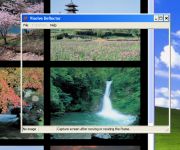
Visolve Deflector
Visolve Deflector

Using a filter, Visolve allows better discrimination of colors by making colors lighter and/or darker, or increasing the saturation.

Unique is the ability to give each color a different hatch pattern, which is very useful for charts or diagrams.

The filters of Visolve:

  • Red/Green filter: red colors lighter, green colors darker
  • Blue/Yellow filter: blue colors lighter, yellow colors darker
  • Saturation filter: increases the intensity of all colors
  • Filtering: colors other than the specified color are darkened
  • Hatching: each color is hatched differently

Platforms:

  • Windows NT, 2000 or XP (probably works on 98 and Me)
  • Mac OS v10.4 or higher (probably also v10.2 and up)

Download: Visolve
Free for personal and non-commercial use.

Daltap by Glenn Heylen
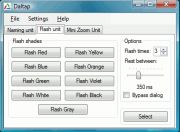
Daltap Flash Unit
Daltap Flash Unit

Daltap has several features combined of which the flashing feature is the most useful. By flashing, it shows where a picked color is on your screen. Next to that, it can give the name of the color at the tip of mouse and it can also zoom in the area that is near the mouse.

The features of Daltap:

  • Naming feature: show the name of the color (basic and detailed)
  • Flashing feature: chosen color flashes on the screen
  • Mini zoom feature: enlarges the area around the mouse

Platform:

  • Windows XP, Vista with Windows .NET Framework 2.0

Download: Daltap
Free to use.

eyePilot™ by Tenebraex
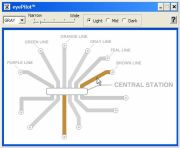
eyePilot Gray Tool
eyePilot™ Gray Tool

Several filters that allows better identification of colors by graying out all colors except the one chosen or by flashing a picked color. It can also make a color turn black by clicking on the name and it can show the name of color. On top of that, it can change the hue of colors, increasing the contrast between colors.

The filters of eyePilot™:

  • Gray filter: all colors gray but the picked color
  • Flashing filter: a chosen color flashes
  • Name filter: shows the name of the color the mouse points at
  • Hue filter: adjusts the saturation of colors

Platforms:

  • Windows NT, 2000 and XP
  • Mac OS v10.2 and higher

Download: eyePilot™
Fully functional trail version for 30 days. Thereafter an activation code is needed for which you have to pay $34.00.

ColorBlindExt by Onkar Rukar, Gaurav Savkar, and Tushar Pagar
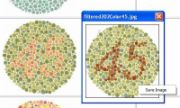
ColorBlindExt
ColorBlindExt

This Firefox add-on offers the possibility to change websites, text and figures such that it is better readable for the colorblind. This can be done while browsing or via a menu with the following filters:

  • Red filter (for protanopia and protanomaly)
  • Green filter (for deuteranopia and deuteranomaly)
  • Blue filter (for tritanopia and tritanomaly)
  • Monochromacy

Platform:

  • FireFox 2.0 or higher with Java Runtime Environment 1.5 or Java Advanced Imaging Run Time 1.1.3 or higher.

Link: ColorBlindExt

Color Blindness Simulation

Color Oracle by Bernhard Jenny and Nathaniel Vaughn Kelso
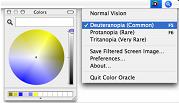
Color Oracle Deuteranopia Settings

Places a filter over the screen to simulate colorblindness directly showing how it looks like for a colorblind person.

Color Oracle can simulate the three main types of color blindness:

  • Deuteranopia (green-blindness: most common form of color vision deficiency)
  • Protanopia (red-blindness: rare form)
  • Tritanopia (blue-blindness: very rare form)

Platforms:

  • Windows 2000, XP or Vista with Java 6
  • Mac OS v10.4 or higher
  • Linux with Java 6

Download: Color Oracle
Free to use.

ColorDoctor by Fujitsu
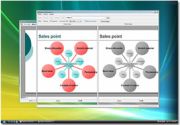
ColorDoctor
ColorDoctor

ColorDoctor not only simulates website display, it is also possible to simulate real-time display of for example moving images such as Flash by selecting the “Transparent” mode. It is possible to show the display content through four different conversion filters:

  • Grayscale
  • Protanopia
  • Deuteranopia
  • Tritanopia

The simulation result can be stored in various file formats, including BMP, JPEG, PNG, TIFF, and GIF.

Platform:

  • Windows XP and Vista with Windows .NET Framework 1.1 or higher

Download: ColorDoctor
Free to use.

Sim Daltonism by Michel Fortin
Sim Daltonism
Sim Daltonism

Sim Daltonism filters in real-time the area around the mouse pointer and displays the result—as seen by a color blind person—in a floating palette.

Sim Daltonism can simulate eight types of colorblindness:

  • Monochromacy (complete)
  • Monochromacy (partial)
  • Protanomaly (red-weakness)
  • Protanopia (red-blindness)
  • Deuteranomaly (green-weakness)
  • Deuteranopia (green-blindness)
  • Tritanomaly (blue-weakness)
  • Tritanopia (blue-blindness)

Platform:

  • Mac OS X 10.2.8 or higher

Download: Sim Daltonism
Free to use.

Online Color Blindness Simulation

Coblis by Colblindor
Coblis - Color Blindness Simulator

Coblis – Color Blindness Simulator

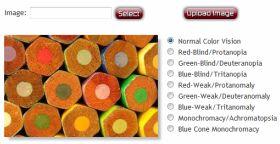
Coblis was designed to help non colorblind people to understand how an image looks like if you have a certain type of color vision deficiency.

You can either try the different types of color blindness on the given sample picture or upload your own images and see how they look if you would be colorblind.

The following types of color blindness are supported by Coblis:

  • Normal Color Vision
  • Red-Blind/Protanopia
  • Green-Blind/Deuteranopia
  • Blue-Blind/Tritanopia
  • Red-Weak/Protanomaly
  • Green-Weak/Deuteranomaly
  • Blue-Weak/Tritanomaly
  • Monochromacy/Achromatopsia
  • Blue Cone Monochromacy

Link: Coblis

Vischeck by Bob Dougherty and Alex Wade
Vischeck
Vischeck Daltonize Tool

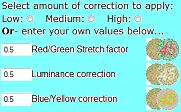
The online service of Vischeck offers two types of simulation:

  • Vischeck: shows how pictures look for colorblind people
  • Daltonize: corrects images if you are colorblind

Vischeck itself can simulate the three main types of color blindness either using an image or by running it directly on a webpage:

  • Protanopia
  • Deuteranopia
  • Tritanopia

Daltonize makes it possible to adjust the ratio of red/green & blue/yellow and brightness of colors of images making them more readable for a colorblind person.

Next to the website, Vischeck offers a plug-in to do the simulations offline with the help of Adobe Photoshop or ImageJ (see Vischeck downloads):

  • VischeckPS – Windows
  • VischeckPS – Mac
  • VischeckJ 1.0

Link: Vischeck

Colorblind Web Page Filter by Matthew Wickline
Colorblind Web Page Filter Settings

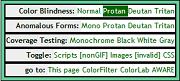
The purpose of colorblind webpage filter is, as the name already suggests, to show how webpages are seen by colorblind people.

To do this, you can choose between all different kinds of color vision deficiency:

  • Monochromacy
  • Blue Cone Monochromacy
  • Protanomaly (red-weakness)
  • Protanopia (red-blindness)
  • Deuteranomaly (green-weakness)
  • Deuteranopia (green-blindness)
  • Tritanomaly (blue-weakness)
  • Tritanopia (blue-blindness)

Additionaly it is possible to toggle stylesheet inclusion, image filtering and the special case of non-gif image filtering.

Link: Colorblind Web Page Filter

Color Vision by Cal Henderson
Color Vision
Color Vision

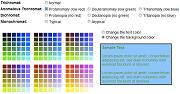
When designing a website, brochures, etc, Color Vision comes in very handy.

On the website you pick text and background color and check how this looks like in the case of:

Trichromat: Normal
Anomalous Trichromat:   Protanomaly Deuteranomaly Tritanomaly
Dichromat: Protanopia Deutanopia Tritanopia
Monochromat: Typical Atypical

Link: Color Vision

Color Recognition

Eyedropper by Inetia.com
Eyedropper

Eyedropper

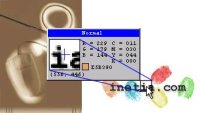
Enlarges the area around the tip of the mouse and tells which color it points to in several different color systems like HEX, RGB, and CMYK.

Next to that, it is possible to make some image capturing or use the value switchable mode, which allows you to choose between normal, grayscale and websafe colors.

Platform:

  • Windows 95, 98, NT, 2000, XP, and Vista

Download: Eyedropper
Free to use.

WhatColor by Hikaru Nakahara
WhatColor
WhatColor Features

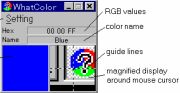
Enlarges the area around the tip of the mouse one to four times and tells which color it points to in several different color systems like RGB, decimal, HSV and HLS.

Additionally it gives the name of the color the mouse points to, which is very handy for colorblind users. And on top of that it can even pronounce the color names.

Platform:

  • Windows 95, 98, Me, NT, 2000, XP, and Vista

Download: WhatColor
Fully functional trail version. Thereafter an activation code is needed for which you have to pay $8.00.

Online Color Recognition

Color Name & Hue by Colblindor
Color Name & Hue

Color Name & Hue

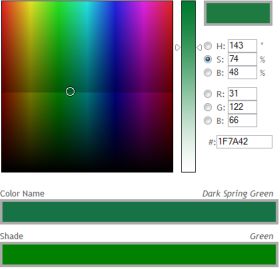
By giving in a color as a RGB, HSB, or hexadecimale colorsystem value, Color Name & Hue associates a color name and the corresponding hue out of more than 1600 colors.

Color names can also be found by placing the circle on one of the main colors followed by moving around the slider to find the hue of the color of interest.

Link: Color Name & Hue

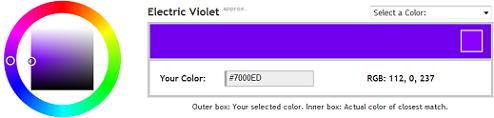
Name that Color by Chirag Mehta
Name that Color
Name that Color

You can either select a color by its name, enter a hexadecimal color value or select a color on a color selector wheel. Name that color will find the closest match out of a list of more than 1500 colors and name it.

Link: Name that Color

Thanks very much to JNvB from www.kleurenblindheid.nl for this comprehensive list of tools for colorblind and not colorblind people. If you know of any more please add them in the comments section.

Euro Coins—A Simple Color Blindness Test

Did you ever wanted to quickly make a color vision test with one of your friends? Put a few euro coins into your pocket and you will always have a simple color blindness test handy and ready to use.

Euro Coins Color Blindness Test
Euro Coins Color Blindness Test — (left) normal vision,
(center) deuteranope simulation, (right) protanope simulation

P. J. Pardo, A. L. Pérez and M. I. Suero, three researchers from the University of Extremadura, Spain, found this simple test while looking for an uncomplicated possibility to test for color vision deficiency. The discovered that there are two different classes of coins:

  • 1, 2, 5 cent coins made of copper-covered steel with a reddish tone.
  • 10, 20, 50 cent coins made of Nordic gold with a yellowish tone.

Measuring the exact colors and calculating the coordinates in the CIE color space showed, that the two different colors are arranged on the deutan confusion line. This means that green-blind people wont be able to distinguish the colors and also red-blind people will have significant problems. So they found a simple possibility to test for red-green color blindness

So this are the facts. And now, how can you perform a color vision deficiency test based on this findings?

  1. Gather 5 coins each from lower and upper values. Use coins from different countries, as they have different back sides.
  2. Mix them and show the coins with the value side facing down to your friend.
  3. Ask your friend to sort all the coins based on their colors.
  4. See how your friend performs on the task.
  5. Explain the facts why this is a valid red-green color blindness test.

Any person with normal color vision should be able to sort them quickly and of course correct. Red-green colorblind people will have more or less problems to sort them and often try to sort them based on brightness. If you try this test on several persons (including colorblind people) you will recognize the difference.

For more details on this test see Euro: A new color vision test in the pockets of three hundred million Europeans.

Happy testing! — Check the color vision abilities of your friends and your family with this simple color blindness test. It would be great to hear some of your experiences. If you like, share them in the comments.

If a Women is a Carrier of Color Blindness does she also Suffer from it?

Many people think that only men can be colorblind. As we can learn from genetics, this is not true. There are a lot more men colorblind, but also women can suffer from a color vision deficiency.

Here’s a question for experts: according to a vision test in a magazine she did recently, my mother has a slight red-green weakness, which, however, is hardly noticeable in daily life. Is this also colour blindness, although that is really rare in women, and it’s nothing compared to her father’s colour blindness, which was pretty severe? Or can it be due to her being a carrier?

On a first glance it looks like we can give a quick and short answer on this. But thinking about it, makes it a bit more complicated.

First of all, yes women can be colorblind and even if it is a very weak form of it you call it color vision deficiency (a wording which reflects much better the fact that colorblind people can also see colors). And it doesn’t matter if it is rare or not.

Sex chromosome X encodes color vision.
XY = man
XX = woman.

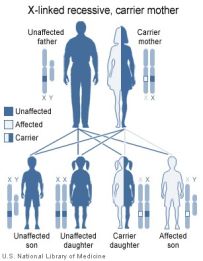
Now let’s have a closer look at this case. We have a colorblind man which means he has a defective X chromosome which pairs with a Y. The Y chromosomes have no coding of color vision and therefore have no important role here. His daughter will inherit this defective X and another X from her mother. We have now to possibilities:

  1. The mothers X is also defective concerning color vision.
  2. The daughter inherited an X encoding perfect color vision.

In the first case the daughter definitely shows some form of color blindness which she inherited from both of her parents. It is said that the weaker form either from her father or from her mother would control her color vision.

X-linked recessive carrier mother

According to genetics the daughter shouldn’t be colorblind in the second case. But it is known from different cases that this isn’t always so easy to tell. Up to now it is not fully understood how those two X chromosomes affect the color vision system. It could be very well that both of them play their part in the setup of the color receptors. In this case the strong color blindness encoded on her fathers X chromosome could also affect the color vision to a certain degree.

Putting this together means, that the daughter can show characteristics of color vision deficiency in the first and the second case. Only a detailed genetic analysis could tell us more details about it.

Color Blindness Simulator: New Tool Released on Colblindor

Did you ever wonder how it looks like to be colorblind? It is not easy at all to describe color blindness in words. But it is much easier to show it on an image, if you have the right tool.

Color Blindness Simulator

Just today I released a second tool on Colblindor. I call it Coblis, a very effective color blindness simulator.

Coblis is based on Michael’s color matrix from ColorJack. Basically the tool manipulates the colors of an image in such a way, that the result is the same image as seen by a particular type of colorblind people.

Let’s have a look what exactly you can do with the color blindness simulator:

  • Choose from nine different color vision types.
  • All possible color vision deficiencies can be simulated.
  • Try out image manipulation with a sample image…
  • …or upload your own image to change its colors as colorblind people perceive them.

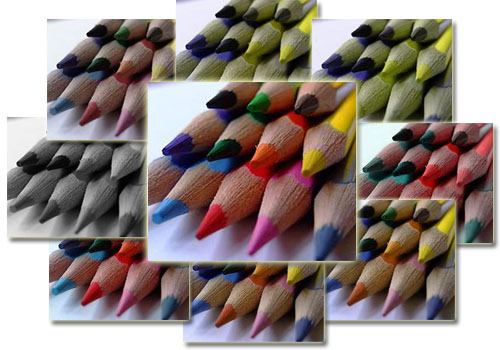
The following gallery should give you a quite good impression of what you can do with the tool. If you start with the image in the center the color blindness simulator will produce the following color blindness views (clockwise): Red-Blind/Protanopia, Green-Blind/Deuteranopia, Blue-Blind/Tritanopia, Red-Weak/Protanomaly, Green-Weak/Deuteranomaly, Blue-Weak/Tritanomaly, Monochromacy/Achromatopsia, and Blue Cone Monochromacy.

Color Blindness Simulator: Example Picture
Color Blindness Simulator: Example Picture (taken by Gaetan Lee)

If you haven’t tried it out yet, this is the time to go and check out Coblis, my color blindness simulator. Comments are very welcome.

RGB Anomaloscope Color Blindness Test:Severity Upgrade

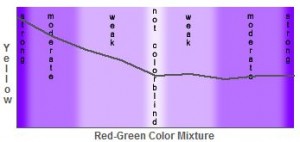
RGB Anomaloscope Severity Diagram

A few weeks ago I released the new RGB Anomaloscope. A slight adjustment was introduced since the first release and I also added a little survey to make it more accurate. Now I’m happy to announce the severity upgrade of the RGB Anomaloscope color blindness test.

The diagram is now split into several colored areas. As your personal matching line starts growing from the center it is possible to find the severity of your red-green color blindness. A very short line in the center means you are not colorblind, compared to a line stretching along the whole diagram which means you are suffering from a strong color blindness.

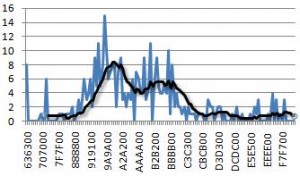
Yellow Diagram matching Red

This update was based on more than 1’000 color blindness tests taken so far.I hope this helps you to find out more about your color vision.

I also checked the resulting matching points and found some interesting facts. The diagram to the side shows the colors which were matched with red.

The interesting fact is, that there are two main areas which can be identified. This points towards a possible differentiation of red- and green-blindness.

Before I release another upgrade including also the type of red-green color blindness I would like to gather some more test data. So stay tuned for a future release of the RGB Anomaloscope.

Can I Pass One Color Blindness Test and Fail at the Same Time Another One?

There are different tests available to check your color vision. Unfortunately they can’t be easily compared one to each other. This yields to the question, can you pass one sort of color blindness tests while failing on other ones?

Have you ever heard of somebody who can pass the D-15 test, but can’t pass an Ishihara plate test? I’ve been told I was colorblind (for 20 years) because I can’t see all the numbers in the bubbles. I finally asked my optometrist what type of colorblind I was (out of curiosity) and he gave me the D-15 test to find out. I passed it with flying colors—all in the correct order.

My optometrist has never seen somebody pass the D-15 and fail the Ishihara (he gave me that as well…). Any ideas?

A very important but in some way hidden message in this question is, that you have to go to your optometrist for a reliable check of your color vision. Online color blindness tests are a good start but not the right tool to get secure test results.

Types of color vision deficiency tests

The most common color blindness tests can be arranged into four main categories. In each of those categories are many different types of tests available, whereas the system of the test stays the same.

  1. Anomaloscope: The most reliable test which can tell you more about the severity and type of your color blindness. My RGB Anomaloscope shows you someway how an anomaloscope works.
  2. Pseudoisochromatic plates: This test category is the most famous one. Invented by Prof. Ishihara they are often called Ishihara plates tests. Based on the idea of colored dots different tests are used.
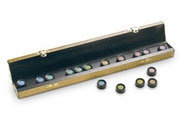
  3. Arrangement tests: This tests are based on differently colored discs which have to be arranged in the correct order. They range from 15 discs (D-15) up to 100 discs.
  4. Lantern tests: The most easiest test category developed over 100 years ago. They were originally used to check if you can work for a railway company and distinguish the different signal lights.
D-15 color blindness test

When you read through the list above you can easily guess that all those different color blindness tests can’t have the same sensitivity. Some are very sensitive like pseudoisochromatic plates. They are sometimes even not readable for people with normal color vision. On the other side the lantern tests are best to check if you are fit to do certain jobs and are not checking if you are only slightly colorblind.

  • Pseudoisochromatic plates, arrangement tests with 100 discs and anomaloscopes are the most sensitive and detailed color vision deficiency tests.
  • Looking at arrangement test you will have less sensitiveness with less discs. I don’t make that many mistakes on a D-15 test but I am very much red-blind.
  • Lantern tests are not good at testing the severity of your color blindness and are the least sensitive tests.

To conclude: you can easily fail an Ishihara plates tests and pass a D-15 arrangement test at the same time. I would say many people with a low to moderate color blindness will receive such a test result.

What I don’t understand is why your optometrist was astonished by your test results…

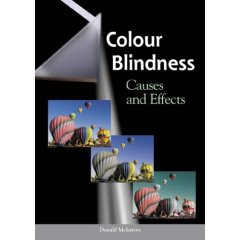
Interview with the Author of Colour Blindness: Causes and Effects

Colour Blindness - Causes and Effects
Colour Blindness – Causes and Effects

The book Colour Blindness: Causes and Effects is one of my favorite sources for all kind of information related to color vision deficiency. About one week ago I was contacted by the author of the book Donald McIntyre.

I invited him to join us for an interview and I am very pleased that he answered me back so quickly. Please read on and learn about Donald’s color vision deficiency—and more.

Colblindor: Are you suffering from any color vision deficiency yourself?
Donald McIntyre: Yes, I am a protanope. That is to say, I completely lack the set of cones in the retina that are sensitive to long wave (red) light. Reds appear very dark to me and I have great difficulty distinguishing among the range of reds, greens and browns (plus several other confusions).

Colblindor: What inspired you to write a book about color blindness?
Donald McIntyre: I have been aware of my colour vision deficiency since childhood. When I tried to find out more, all I could find were simple one page magazine articles, or highly academic research publications. There was a need for a book that explained colour vision deficiency to the ordinary reader, but in sufficient depth to answer the many questions that arise. Since the book didn’t exist, I decided to write it myself.

Colblindor: If you would write it again, which aspects would you highlight more deeply?
Donald McIntyre: It would have been nice to have time to find more anecdotes about the experiences of colour-blind people in different walks of life. Has any footballer ever passed the ball to the wrong side? I couldn’t find one to speak to.

Colblindor: Do you think there will be a treatment of color blindness in the near future?
Donald McIntyre: Unfortunately not. The computer-based simulations can give a very good idea to the colour normal of what we colour defectives see. But not the other way round!

Colblindor: What do you think about the fact that many colorblind people can’t become pilots, police officers or firefighters?
Donald McIntyre: The problems with colour vision deficiency become serious when a person has to make a critical decision on their own, especially where safety is involved. For instance, there are successful colour-blind electronic engineers who carry out development work in the lab. However, no colour-blind engineer should install or repair wiring in the field.
An important and often overlooked fact is that there are degrees of severity in colour vision deficiency. Protanopia (my sort) is the worst. At the other end of the range of severity, mild deuteranolamy involves a slight shift in the sensitivity of the middle wave cones and may not be a problem in many jobs. The commonly used Ishihara test is very sensitive and will pick up the mildest defect. If a person feels they have been unjustly barred from a profession, they can ask for a more detailed vision assessment and argue their case.

Colblindor: What would you tell a person who just found out that she is colorblind?
Donald McIntyre: First of all, it’s not that serious. Many people do not realise that they have one of the milder forms of colour vision deficiency until adulthood, perhaps when they are tested when applying or a job. It is worth finding out about colour-blindness at a young age, to avoid training for a profession that may produce problems later on. I would not go along with those who say the colour deficient view of the world is “equally valid”. We do lose out on some of the pleasure that colour can give, but there are plenty of other delights in the world.

Dear Donald, thank you very much for your time, for joining the interview and of course for your book.

New Release of the RGB Anomaloscope Color Blindness Test

I released the first version of the RGB Anomaloscope about a half a year ago. Since then more than 15’000 tests have been taken from many thousand colorblind and not colorblind people all around the world.

During this time I learned a lot more about this test and that’s why I updated it. So today I would like to announce the second release of the RGB anomaloscope color blindness test. It is still not like a real anomaloscope because of the three color limitation of computer displays (RGB). But I hope with this improvements we will get some better results and can give you a better prediction of the severity and type of your red-green color blindness.

The following attributes of the test have been adjusted:

  • The to be matched colors have all the same brightness now. This makes the result easier for comparison.
  • Instead of matching red or green to a yellow color, you have to match now some sort of yellow to different red-green mixtures. This gives a better readable test result.
  • To get a more precise test result, the selection of the last color matches is based on your ongoing test.
  • The test shows now a line instead of only circles. With this adjustment you can easier spot your personal result.

The most important adjustment is based on the equal brightness of the colors to be matched. This should make it easier to spot red-blind compared to green-blind people. If you have some sort of red-blindness, the green color shades look much brighter than red ones. And this is only true for red-weakness or red-blindness.

Enough of talking, just check out the new RGB Anomaloscope Color Blindness Test. Hope you like it.

The Most Frequently Asked Questions on Color Blindness

Since I started Colblindor more than two years ago I posted 233 articles, count as of today 623 comments and I was contacted more then 350 times—with increasing frequency. So I thought it is about time to write an FAQ on color blindness.

So far I put together the six top questions I get asked almost on a daily basis.

You can find the detailed answers at full length under the separate page Color Blindness — Most Frequently Asked Questions. In this short article I will only feed you with some very compact answers.

FAQ Color Vision Deficiency

  • Is there a cure for color blindness? — No. There are some scientists experimenting with color vision genes, but this won’t be available in the near future.
  • Can I correct my color blindness? — No. Neither glasses nor lenses or any other tools can correct it. But some of them may shift your spectrum of color sensation.
  • How can I pass the Ishihara test? — If you are colorblind, you can’t pass it. Some lenses might help you but are usually not allowed during testing.
  • Is my son colorblind? — Don’t be concerned. Wait until he goes to kindergarten and then ask yourself this question again.
  • Can women also suffer from color vision deficiency? — Yes. About 0.5% of all women are colorblind; 16 times less than men.
  • Which type of color blindness am I suffering from? — Only your eye specialist can tell you that. But some online color blindness tests might give you some clues.

If the answers were just to short, read them at full length. But if your question isn’t mentioned at all, don’t hesitate to contact me.