Yesterday my wife and I went past a plant in our garden. She told me about how she likes the red blossoms of it and only in this moment I realized, that this bush has blossoms at all.
Before yesterday I walked past a green bush day after day. Because of my color blindness (I’m very much red-blind) I never realized that during the last beautiful early summer days it had developed such nice blossoms.
Red Spring Blossoms
Now I know about the blossoms and therefore I can see them. But still, they don’t catch my eye and seeing them through my colorblind eyes they are very well hidden inside the green leaves.
For me this is a very typical example how a colorblind sees the world different than somebody with normal color vision. But do you really miss something if you just can’t see it?
Deutan color vision deficiencies are by far the most common forms of color blindness. This subtype of red-green color blindness is found in about 6% of the male population, mostly in its mild form deuteranomaly.
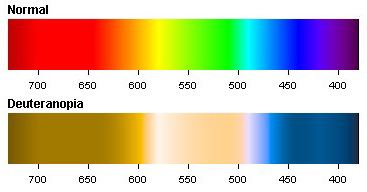
Normal and Deuteranopia Color Spectrum
When you have a look at the color spectrum of a deuteranopic person you can see that a variety of colors look different than in a normal color spectrum. Whereas red and green are the main problem colors, there are also for example some gray, purple and a greenish blue-green which can’t be distinguished very well.
The well known term red-green color blindness is actually split into two different subtypes. On one side persons which either lack or have anomalous long wavelength sensitive cones (protan color vision deficiency), which are more responsible for the red part of vision. And on the other side deutan color vision deficiencies, which again are split into two different types:
Dichromats: Deuteranopia (also called green-blind). In this case the medium wavelength sensitive cones (green) are missing at all. A deuteranope can only distinguish 2 to 3 different hues, whereas somebody with normal vision sees 7 different hues.
Anomalous Trichromats: Deuteranomaly (green-weak). This can be everything between almost normal color vision and deuteranopia. The green sensitive cones are not missing in this case, but the peak of sensitivity is moved towards the red sensitive cones.
Below you can see a picture with normal colors on the left side and altered colors on the right side. The picture on the right side shows you how a person affected by deuteranopia would see the scenery (picture taken by Ottmar Liebert, some rights reserverd).
Normal Vision
Deuteranopic Vision
In the midst of the last century there were different researches published concerning unilateral deuteranopia. Some persons were found which had trichromatic vision in one eye and dichromatic vision in the other. The eye with dichromatic vision had a color specturm related to a deuteranopia color spectrum. One case of such a one-eyed colorblind is described in the article The Spectral Luminosity Curves for a Dichromatic Eye and a Normal Eye in the Same Person.
The one-eyed color blindness is definitely not the common case, whereas deuteranopia and especially deuteranomaly are the most observed cases of all color vision deficiencies. In 75% of all occurrences of color blindness it is a defect caused by the green sensitive cones. The following list shows the approximative rates of deutan defects in our population:
Deuteranomaly, Male Population: 5%
Deuteranopia, Male Population: 1%
Deuteranomaly, Female Population: 0.35%
Deuteranopia, Female Population: 0.1%
These numbers don’t change much, because deutan color blindness as one form of red-green color blindness is a congenital disease. Red-green color blindness is a sex-linked trait and therefore encoded on the X chromosome. Because women have two X and can overcome the handicap of one, men have only one and are therefore more often affected. This circumstance can also be read in the numbers of the table above. More details about the concrete inheritance pattern can be found at The Biology behind Red-Green Color Blindness.
If you are colorblind there is a big chance that you are red-green colorblind, usually green-weak and male. And if you are suffering from deuteranomaly I just want to let you know, that you are nothing special…
Read more about Tritanopia and Protanopia—the other two types of color blindness.
Peter Jones, president of Tenebraex, is a really clever business man. He is making the headlines every few month with some new announcements. This time featured at cnet news.com with the article Bringing color to the colorblind.
It was just about one year ago when the company was in the news with their software called eyePilot. This is a little software tool which helps colorblind people to distinguish and name colors on the computer. I reported about it in the Battle against color blindness with eyePilot and the follow-up post on RGB is not HSV.
Then again when school started last summer, they pushed their tool into some news channels and promoted it further. This time they focused at schools. EyePilot could help many children at school time to overcome their handicap of color blindness—at least in some cases.
Last time I heard about the company was November 2006 when I was contacted by Joanna L. Ossinger from the Wall Street Journal. She wrote an article about tools which help colorblind people and asked me for my opinion. Afterwards I had to ask myself if journalists have a work ethic, because after she got the information I never heard again a word and was mentioned by no word.
Color Reading Cell Phone
And here we are again. This time they neither have a new product to announce nor push their old one again. No, this time they just talk loudly about their ideas and are mainly looking for, well, money. Their new idea is a color reading cell phone.
This idea isn’t that new. The Color Luminator is a similar tool which was already developed by some smart students. Ok, it’s not a cell phone. But these days almost anything could be packed into a cell phone, if you only have a enough money.
From a business perspective, they definitely go the right way. I suppose they already made good money and will grow further with their well established tactics.
From a colorblind perspective it looks different. I did put together the following wish list for Tenebraex:
Release eyePilot to the open source community. This way it could evolve to a nice little application which doesn’t just look like a fast hack with a big marketing machine behind it.
Develop some great plugins for eyePilot. Those will enhance the product and make it a real nice helper tool for every colorblind person. With this strategy you could even earn some money.
Then show us, that you really have something more to offer than just some ideas. Maybe you could get some help from the Color Luminator guys.
After all that, approach cell phone companies and tell us, when you’re done.
If you follow this task list we will maybe soon have some great tools available for all among us affected by color blindness. Otherwise it might take some longer.
A Great Big Nerd opens the curtain and tells us some stories about his life with color blindness. Very typical stories, which every colorblind among us knows by heart.
If you are colorblind, you know it, the same old question when someone learns about your color vision deficiency.
If you know a colorblind, it’s the first question you ask him (or in some uncommon cases her).
“What color is this?”
Do we really need to know? Our Nerd puts it this way:
Me: “There is our car, between those two blue cars.”
Em: “Where?”
Me: “Right there! Between the blue ones!”
Em: “Um, those cars are both green.”
Me: “Oh.”
So don’t be to pedantic. We are all living on the same Wonderful World of Color but just experience it differently.
I would like to welcome everybody to the second edition of Carnival of Colors. This time we could double the entry count and have now four interesting topics to look at. If this carnival keeps growing at this rate, it could get really big—so stay tuned.
Last time we looked at the color Blue. This time we move on at the color circle to the color Green and have a look at it from very different perspectives.
Green
« Green is the color that elicits relaxation. – This is the closing note of Deborah, known as Dr. Deb, in her contribution Want To Succeed? Don’t See Red. Luckily enough I am red-green colorblind and can’t really be distracted by neither. »
« Maureen presents Components Of A “Green” Home while she is looking forward into retirement and gets prepared for it. In her Empty Nest she moves the color Green into the environmental perspective. »
« You got me Mike. Color Me Fulvous could simply be renamed into Color Me Green because there is no difference to me between the yellow-brown color fulvous and green. That’s maybe why I will unfortunately never spot your 10,000 Birds. »
« After all this maybe Green is your choice of color? Karen writes about The Perception of Life; a perception which is not only black and white. Please, make your choice and Live The Power. »
To understand the how and why of the two color translations we first have look at the RGB color system. The acronym RGB encodes the colors Red, Green and Blue and is used on computer system color displays to—well— display colors.
Concerning red-green color blindness the first two channels (Red/Green) are sometimes not of great help. These two channels are encoding the color axis which gives a red-green colorblind person the most problems in distinguishing different shades. Therefore we are looking for a simple way to transform those two channels.
Red-Green Color Blindness Color Translation Algorithms
Red-Green to Blue-Yellow Translation
R -> B
G -> G
G -> R
Red-Green to Green-Magenta Translation
R -> R
G -> G
R -> B
The two translation formulas are held very simple but not less effective. They have only one major flaw: the blue channel is completely thrown out and in both cases replaced by the red channel. So you lose a third of the information in the image, all the blue information, except that if you are red-green colorblind you gain a lot of information that was previously lost in the red and green channels.
As Peter, the owner of Protanope Tools, puts it:
I say this is a strength because the simplicity makes it easy to understand exactly what’s happening, so if you know you’re going to lose all the blue information at least that won’t take you by surprise.
Thanks Peter for the information about your simple color translation algorithms you shared with us.
It’s not always easy to live with your color blindness. One special case are all those color coded wires.
I recently came across this problem, when I tried to elongate a telephone cable. This can be a big problem if you are colorblind and have nobody around who can tell you which color is which and has to be connected to which port.
Brandon describes a similar problem while he was rewiring some cables in his house. He vent his anger in When Color Blindness Sucks.
What do we learn:
Don’t work with color coded wires if you are colorblind.
Because almost everything is color coded these days, stop working at all.
Ask the government for support because you can’t work.
Sit back and think what you could do in your spare time.
Maybe some new rewiring of your cables at home?….
Dear colorblind fellows, do you have similar experiences with color codes?
As for today there is no known treatment to cure color blindness but maybe in the near future there will be some possibilities to overcome color blindness and even enhance color vision overall.
Researchers from the University of California and the Johns Hopkins Medical School in Baltimore showed in a series of experiments, how the color vision abilities of mice can be enhanced. Mice have naturally only dichromatic vision which can be compared to red-green color blindness. Dichromatic means, they have only two different types of color receptors in their eyes whereas humans normally have three different types which make up our color vision.
The scientists “pimped” the mice in their experiments with the missing genes for color perception which they took from humans. And those mice performed much better in the test setup as their dichromatic colleagues. This led to the assumption that the enhanced mice have a better (trichromatic) color vision.
Other researchers have also shown that they could cure color blindness in monkeys through injections of the missing color receptor genes.
What can we learn from this?
Color Blindness can be cured or at least it could be cured in about 6 cases of mice and monkeys so far.
We are on the way of the perfect human being and don’t even forget to exterminate color blindness on that way.
You won’t experience the cure of color blindness because this are only the first steps from a very long way.
If you are looking for a treatment of color blindness you still need to wait quite a while. And in case you can’t wait—hope dies last.
Earlier this month Anthony Mitchell from TechNewsWorld wrote a nice article about the usability of products and the communication of information concerning color blindness. Due to the fact that about 8% of men have a color vision deficiency this is nothing to be neglected.
The two parts of the article cover topics like good contrast colors, presenting with color blindness in your mind, color coding, and poor usability through bad color choices.
A few statements caught my attention which I would like to point out:
Information should never be distinguished by color only. This is a very important point which is often forgotten about. Only three different colors with high contrasts are easily distinguishable for colorblind persons. Always try to make not only color the only attribute but also use patterns, thickness of lines or borders or simply label the different parts directly if possible.
Colorblind people have trouble seeing light from red laser pointers. Laser pointers always give me a hard time. If they are used on presentations I have great difficulties to see the little dot. Often I concentrate so much on the red dot that I even loose track of the presentation itself.
Rely on black fonts and white backgrounds. It’s so simply why don’t you stick to it? Of course this is not true in all cases but for a text which should be easily readable for everybody just stick to black and white.
Colorblind people can find it impossible to distinguish red letters from black ones. This point is sometimes hard to believe by somebody with normal color vision. But red text doesn’t stick out at all if you are colorblind. If you use red text to show some errors for example in an input form invert the colors, make it bold, print a border or just do anything to make it more visible.
Distinguishing colors and naming colors are separate tasks. When it comes to naming colors I’m really bad. And with really bad I mean really really bad. I can distinguish colors but usually have big problems naming them. Color blindness makes you a color names guessing individual and not knowing one.
The article also includes a whole lot of links to better and worse examples: colors used in icons, webpages, links, and a lot more.
Maybe one or the other tip can help you to present your products more colorblind friendly or get your point across easily even with colorblind persons in your audience. You can find the whole article by following the two links below.
There are many online tools which help you to choose an appropriate color scheme based on color theory. ColorJack is one of them. But not just anyone when you take color blindness into account. The creator put quite some effort into the tool to help you understand how a colorblind persons will perceive your chosen color scheme.
The most popular part of ColorJack is the Sphere application. Before I describe you all settings in detail and special adjustments concerning color blindness try it out yourself.
Besides all the settings for choosing your spectral colors according to different color theories and the possibility to set the base color spectrum you have the choice to choose between several different color vision deficiencies.
Dichromacy: Protanopia, Deuteranopia and Tritanopia.
Anomalous Trichromacy: Protanomaly, Deuteranomaly and Tritanomaly.
Monochromacy: Rod Monochromacy and Blue Cone Monochromacy.
The naming needs some further explanation because the labels in the Sphere tool are not well chosen. As for dichromacy which describes the circumstance, that a person has one type of color receptors missing, the correct names end with -opia and not as labeled in the tool with -opy.
The wordings Achromatopy and Achromatomaly used in the tool of ColorJack are also wrong. The correct names are either Rod Monochromacy or Achromatopsia for complete color blindness (absence of all color receptors) and on the other side, if you have only blue color receptors this is called Blue Cone Monochromacy.
Nevertheless the ColorJack Sphere application is a great tool to provide you some good information when you want to check your color scheme to work with any type of color blindness. It does not only show how your colors are perceived by somebody with a color vision deficiency but also shows the according color values. This gives you a hint on how color vision is different if you suffer from color blindness.